
Coding Math Readiness Calculator
This tool assesses your confidence in basic math concepts needed for beginner coding. You don't need advanced math to start - just these essentials:
Answer these simple questions to see your readiness for starting coding.
Your Coding Math Readiness
You’ve signed up for your first coding class. You open the syllabus. And there it is - a list of prerequisites. One of them says: basic math skills. Your heart sinks. You’ve always struggled with algebra. You barely passed high school calculus. Now you’re wondering: Do I even belong here?
The short answer? No, you don’t need advanced math to start coding. Not even close.
Most people who learn to code - whether they’re building websites, mobile apps, or simple automation tools - use less math than they do when balancing a checkbook or calculating a tip. The fear of math is one of the biggest blockers for beginners. And it’s completely unnecessary.
What Math Do You Actually Use in Coding?
Let’s be clear: coding isn’t math class. You won’t be solving differential equations or proving theorems. What you do need is a basic understanding of a few concepts:
- Arithmetic: addition, subtraction, multiplication, division. You’ll use these when calculating prices, scores, or time differences.
- Basic algebra: knowing how to rearrange a formula like
x = y + 5. This shows up in logic, not equations. - Boolean logic: true/false, AND/OR/NOT. This is the backbone of conditional statements like
if (user.age > 18). - Percentages and ratios: useful for UI scaling, progress bars, or data analysis.
- Basic geometry: coordinates, distances, angles - only if you’re working with graphics or games.
That’s it. That’s the entire math toolkit for 90% of coding jobs.
Think of it this way: when you write a script to automatically rename 100 files, you’re not doing calculus. You’re telling the computer: take this name, add a number, save it. That’s logic, not math.
Where Math Actually Matters in Coding
There are exceptions. But they’re niche.
If you’re building a 3D game engine, you’ll need linear algebra for rotations and lighting. If you’re training machine learning models, you’ll need statistics to interpret results. If you’re working in finance or robotics, you’ll deal with complex formulas.
But here’s the catch: you don’t start there.
Most developers never touch those areas. The vast majority of coding work - web development, app design, data entry automation, content management systems - relies on libraries and frameworks that already handle the heavy math for you. You just plug in the inputs and get the output.
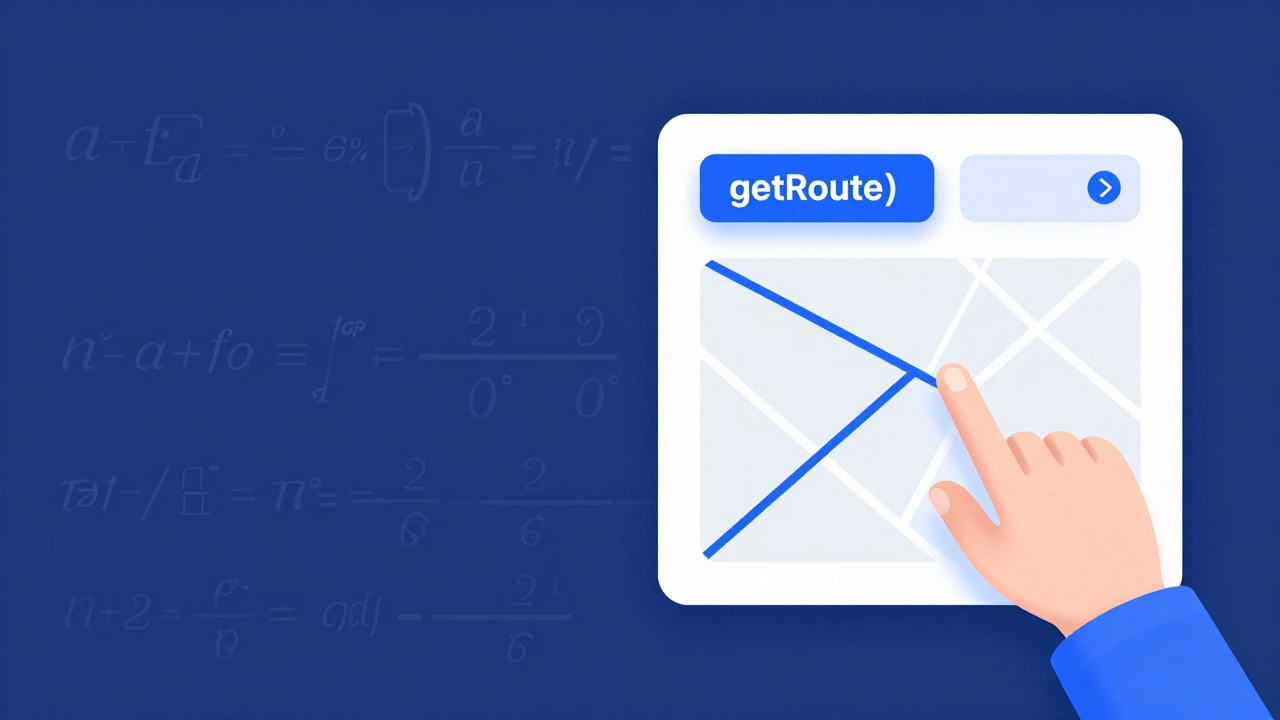
For example: if you’re using a map API to show directions, you don’t need to know how the algorithm calculates the shortest path. You just call getRoute(start, end). The math is buried inside the library. Your job is to use it correctly.
Why Do People Think Coding Needs Math?
This myth comes from three places.
First, computer science degrees often require calculus and discrete math. That’s because universities train theorists, not practitioners. A CS professor might spend years proving how an algorithm works. A software engineer spends days making sure the app doesn’t crash when 10,000 people click a button at once.
Second, early programming tutorials often used math-heavy examples. “Write a program to calculate Fibonacci numbers” - sounds impressive, but it’s just a loop with addition. You don’t need to understand the math behind Fibonacci to write the code.
Third, some recruiters and hiring managers still list “math skills” as a requirement because they don’t know the difference between coding and engineering. They’re looking for a checklist, not a real skill set.
The truth? Companies like Google, Meta, and Airbnb hire thousands of developers every year who never took a math class beyond high school. What they look for is problem-solving, persistence, and the ability to read documentation.
Real Examples: Coding Without Math
Let’s look at real projects people build without touching advanced math:
- A student builds a to-do list app that sends reminders. Uses: strings, dates, conditionals. Math: zero.
- A small business owner automates invoice generation from Google Sheets. Uses: text manipulation, loops, file exports. Math: basic addition.
- A teacher creates a quiz tool that randomly picks questions from a list. Uses: arrays, random selection. Math: counting items.
- A hobbyist writes a script to organize their photo folder by date. Uses: file system commands, date parsing. Math: none.
These aren’t beginner projects. These are real tools people use daily. And none of them require more than elementary arithmetic.
What You Actually Need to Learn
Instead of worrying about math, focus on these four skills:
- Logical thinking - breaking problems into steps. Like planning a recipe: chop onions, heat pan, add garlic.
- Pattern recognition - noticing when you’ve done something similar before and reusing it.
- Attention to detail - one missing semicolon can crash your whole program.
- Debugging patience - learning to read error messages and trace what went wrong.
These are skills you can build in weeks, not years. And they’re far more useful than knowing how to solve a quadratic equation.

What If You’re Still Worried?
Here’s a simple test: open a free coding platform like freeCodeCamp or Codecademy. Start the first HTML/CSS lesson. Then move to JavaScript basics.
After two hours, ask yourself: Did I need to calculate anything?
Chances are, you didn’t. You were just typing commands, seeing what happened, and fixing mistakes. That’s coding.
If you’re still nervous, try this: write down the math you’re afraid of. Then Google: “how is this used in web development?”
You’ll find almost nothing. Not because it’s hidden - because it’s irrelevant.
Math Is a Tool, Not a Gatekeeper
Think of math like a wrench. You don’t need a full toolbox to fix a leaky faucet. You just need the right tool for the job.
Most coding jobs? You need a screwdriver. Maybe a tape measure. You don’t need a torque wrench unless you’re building a jet engine.
And even then - you don’t learn the jet engine first. You learn how to fix a bike. Then a car. Then, maybe, you get to the plane.
Start simple. Build something small. Get comfortable with the process. The math will come only if you need it - and even then, you’ll learn it as you go, not before.
Final Thought: You’re Not Behind
There’s a myth that coding is for “math people.” That’s false. It’s for problem solvers. And problem solving has nothing to do with how well you did in algebra class.
People who struggle with math often make better coders. Why? Because they’re used to figuring things out step by step. They’re patient. They don’t expect things to make sense right away. That’s the exact mindset you need.
You don’t need to be good at math to code. You just need to be willing to try.
Do I need to know calculus to learn coding?
No. Calculus is rarely used in everyday coding. It’s only relevant in specialized fields like physics engines, machine learning, or financial modeling - areas most developers never touch. You can build websites, apps, and automation tools without ever seeing a derivative.
Can someone who’s bad at math become a programmer?
Absolutely. Many successful developers struggled with math in school. Programming is about logic, not numbers. If you can follow instructions, spot patterns, and fix mistakes, you have everything you need. The math you’ll use is basic arithmetic and boolean logic - things you can learn in a day.
What math should I review before starting coding classes?
Just review basic arithmetic: addition, subtraction, multiplication, division. Understand how percentages work. Learn what true/false means in logic. That’s it. Skip algebra, trigonometry, and calculus. You won’t need them for at least the first 6-12 months of learning.
Is coding harder if you’re not good at math?
Not at all. In fact, people who aren’t confident in math often become better coders because they focus on clear logic and step-by-step thinking. Coding isn’t about finding the right answer - it’s about building a reliable process. That’s a skill anyone can learn.
Will I be at a disadvantage in job interviews without strong math skills?
Only if you’re applying for roles in data science, AI, or game development. For 90% of coding jobs - web development, mobile apps, backend systems, IT support - interviews focus on problem-solving, communication, and building real projects. Companies care more about your GitHub repo than your GPA in calculus.