
English Fluency Action Planner
Your Personalized Roadmap
💡 Pro Tip: The Mistake Quota
To break the perfectionism loop, set a goal to make 5 mistakes during your "Real World" practice. If you make them, you win!
Key Takeaways
- Fluency isn't about perfection; it's about communication and flow.
- Anxiety triggers a 'fight or flight' response that shuts down the language center of the brain.
- Consistent, low-stakes practice is more effective than intense, occasional study.
- Shifting focus from yourself to the listener reduces social anxiety.
Why Your Brain Freezes When You Speak
Ever wonder why you can write a perfect email but struggle to say "Hello" in a meeting? It's because speaking happens in real-time. When you write, you have a safety net. When you speak, you're exposed. Foreign Language Anxiety is a specific type of nervousness experienced by people learning a second language, often rooted in the fear of negative evaluation. This isn't just "being shy"; it's a physiological reaction. Your amygdala-the brain's alarm system-sees a potential social mistake as a threat, which floods your system with cortisol and makes you forget basic vocabulary.
To beat this, you need to desensitize your brain. You have to prove to your nervous system that making a mistake in English isn't a life-threatening event. Start by accepting that mistakes are the only way to get better. If you never say anything wrong, you're likely playing it too safe to ever actually improve your speak fluently skills.
The Low-Stakes Practice Method
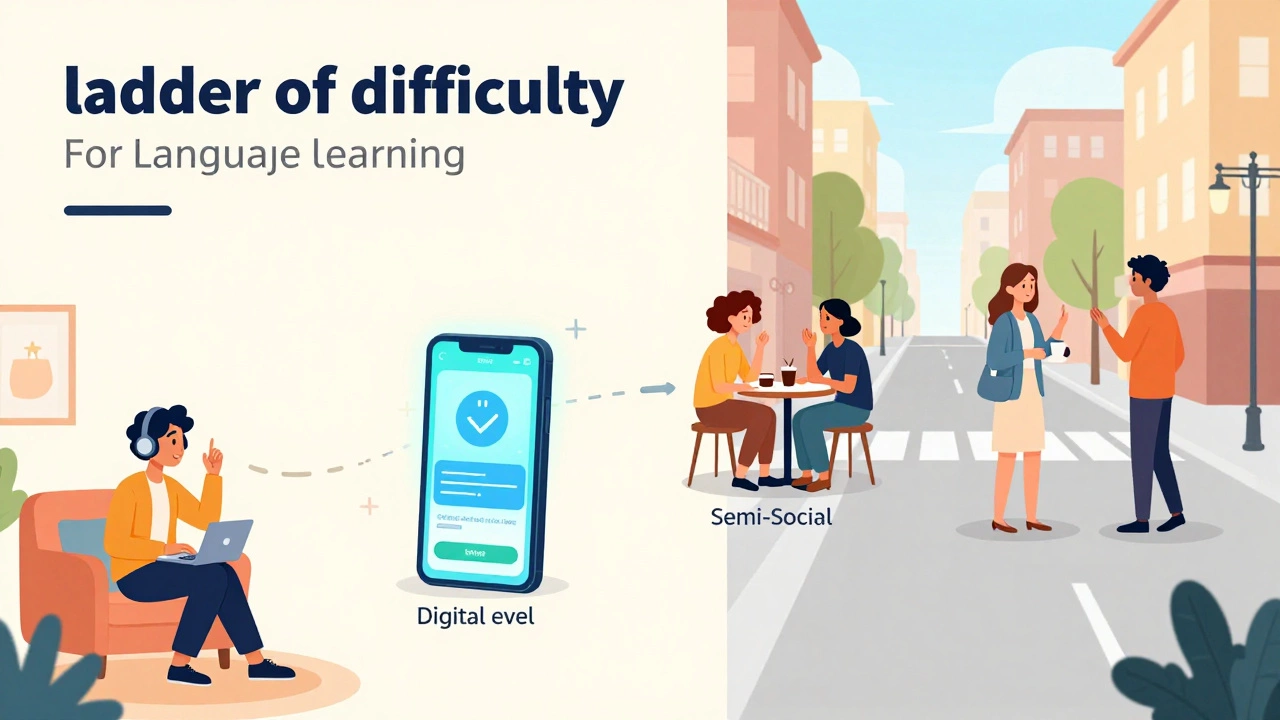
You wouldn't run a marathon without jogging first. Why try to lead a boardroom presentation when you're still scared to talk to a stranger? The secret is to create a ladder of difficulty. Start with "zero-risk" environments where no one is judging you.
One of the most effective tools is Shadowing, which is a technique where you listen to a native speaker and repeat exactly what they say with as little delay as possible. This mimics the natural rhythm and intonation of the language without the pressure of a conversation. Try doing this with a podcast or a YouTube video for 10 minutes a day. Because you aren't creating the sentences, your brain focuses entirely on the muscle memory of speaking.
Another great trick is talking to yourself. Describe your day while you're doing the dishes: "Now I'm scrubbing the pan, and then I'll dry it with a towel." It sounds crazy, but it bridges the gap between your internal thoughts and your vocal cords. When you eventually talk to another person, your mouth is already warmed up.
| Level | Activity | Risk Level | Goal |
|---|---|---|---|
| 1. Solo | Shadowing / Talking to yourself | Zero | Muscle memory & Pronunciation |
| 2. Digital | Voice notes / Language apps | Low | Structuring thoughts |
| 3. Semi-Social | Language exchange partners | Medium | Managing real-time reaction |
| 4. Real World | Ordering food / Small talk with strangers | High | Applying fluency in public |
Moving from Accuracy to Fluency
One of the biggest traps learners fall into is the "Perfectionism Loop." You stop mid-sentence to find the exact right word, which creates a long pause, which makes you nervous, which makes you forget more words. To break this, you need to prioritize Communicative Competence. This is the ability to convey a message effectively, even if the grammar isn't 100% correct.
Use "fillers" and "circumlocution." Circumlocution is just a fancy word for describing something when you forget the specific term. If you forget the word "refrigerator," don't freeze. Say, "the cold box in the kitchen where we keep the milk." Native speakers do this all the time. Using phrases like "Let me think..." or "How do you say..." gives your brain a few extra seconds to recover without the silence feeling awkward.
Focus on phrases, not words. If you learn the phrase "I was wondering if..." as one single unit of sound, you don't have to think about the grammar of each individual word. You just trigger the whole block of sound. This is how you achieve that smooth, flowing quality that people associate with fluency.
Managing Social Anxiety in Real Conversations
When you're actually in a conversation, your focus usually turns inward. You're thinking, "Do I sound stupid?" or "Did I use the wrong tense?" This internal monologue is the enemy of fluency. The trick is to shift your attention entirely onto the other person.
Become an active listener. When you focus on the details of what the other person is saying-their tone, their expression, the specific points they're making-you have less mental energy available to be anxious. Ask open-ended questions. This puts the "burden" of speaking on the other person and gives you time to breathe and plan your next response.
Also, remember the "Spotlight Effect." This is a psychological phenomenon where we overestimate how much others notice our flaws. In reality, most people are just happy that you're trying to communicate with them. They aren't counting your grammar mistakes; they're listening to your ideas. If you make a mistake and keep going without apologizing, most people won't even register it.

Building a Long-Term Fluency Habit
Fluency isn't a destination you reach and then stop; it's a fitness level you maintain. If you stop speaking for a month, your "speaking muscles" will atrophy. You need a system that integrates English into your lifestyle so it doesn't feel like a chore.
Try a Language Exchange, which is a mutual agreement where two people speak each other's native languages to help one another learn. Apps like Tandem or HelloTalk allow you to find partners globally. The key here is to set a specific goal for each session, like "Today I will talk about my favorite movie for 5 minutes," rather than just "chatting." This gives you a structure to lean on when the nerves hit.
Set a "Mistake Quota." Tell yourself that you *must* make at least five mistakes in every conversation. When you frame mistakes as a goal rather than a failure, the fear disappears. You stop avoiding difficult words and start experimenting. That experimentation is where the actual growth happens.
Does listening to podcasts actually help me speak?
Listening helps your "input," but it doesn't automatically translate to "output." To make podcasts helpful for speaking, you must engage with them actively. Use the Shadowing technique mentioned above-repeat the sentences out loud. If you just listen passively, you'll understand English better, but you won't necessarily speak it more fluently.
What should I do if I completely forget a word mid-sentence?
Don't panic or stop talking. Use circumlocution-describe the object or concept using words you do know. For example, if you forget "stapler," say "the thing used to put papers together." You can also use filler phrases like "It's on the tip of my tongue" to maintain the flow of the conversation while your brain searches for the word.
How long does it take to stop feeling afraid when speaking?
There is no magic date, but most learners see a significant drop in anxiety after about 30 to 60 days of daily, low-stakes speaking practice. The goal isn't to eliminate the fear entirely-even native speakers get nervous-but to make the fear small enough that it doesn't stop you from talking.
Should I focus on my accent to be more fluent?
Accent is different from fluency. Fluency is about the flow of ideas; accent is about the sound of the letters. Focus on clarity and rhythm first. As long as you are intelligible, your accent is part of your identity. Obsessing over a perfect accent often increases fear and slows down your speaking speed.
Can I become fluent if I don't have anyone to talk to?
Yes, to an extent. You can use self-talk, recording your own voice and playing it back, and Shadowing. However, real-time interaction is the only way to practice the "social" side of fluency. Use free language exchange apps to find partners if you don't have anyone locally.
Next Steps for Different Learners
If you're a complete beginner, don't jump into conversations yet. Spend two weeks on Shadowing and talking to yourself in the mirror. Get your mouth used to the shapes of English words first.
For intermediate learners who are "stuck," start a mistake journal. Write down the mistakes you're most afraid of making and then intentionally make them in a low-stakes conversation. Once you see that the world doesn't end when you use the wrong preposition, your confidence will skyrocket.
If you're an advanced learner struggling with professional settings, record your meetings (with permission). Listen back to find where you hesitate. Those hesitations are usually where your confidence dips. Practice those specific transition phrases until they become automatic.