
CBSE vs American School Difficulty Calculator
Your Profile Configuration
Analysis Results
CBSE Load
Memorization & VolumeUS Load
Activities & HolisticInsight:
Imagine two students. One is in New Delhi, studying for the Central Board of Secondary Education (CBSE) Class 12 board exams. The other is in Los Angeles, preparing for their SATs and AP tests. Who is working harder? Who is stressed out more? And who actually learns more?
This question comes up constantly in global classrooms, online forums, and family dinners across India and the United States. Parents often ask if switching systems will be easier for their kids. Students wonder if they are being treated unfairly by one system over the other. The short answer? It’s not about which one is "harder" in a vacuum. It’s about *how* they are hard. One is a marathon of memorization and high-stakes testing. The other is a sprint of diverse activities, critical thinking, and holistic evaluation.
To understand the real difference, we need to look past the stereotypes. We need to look at the daily grind, the exam structures, and what happens after graduation. Here is a breakdown of why comparing these two systems is like comparing apples to oranges-and why that matters for your future.
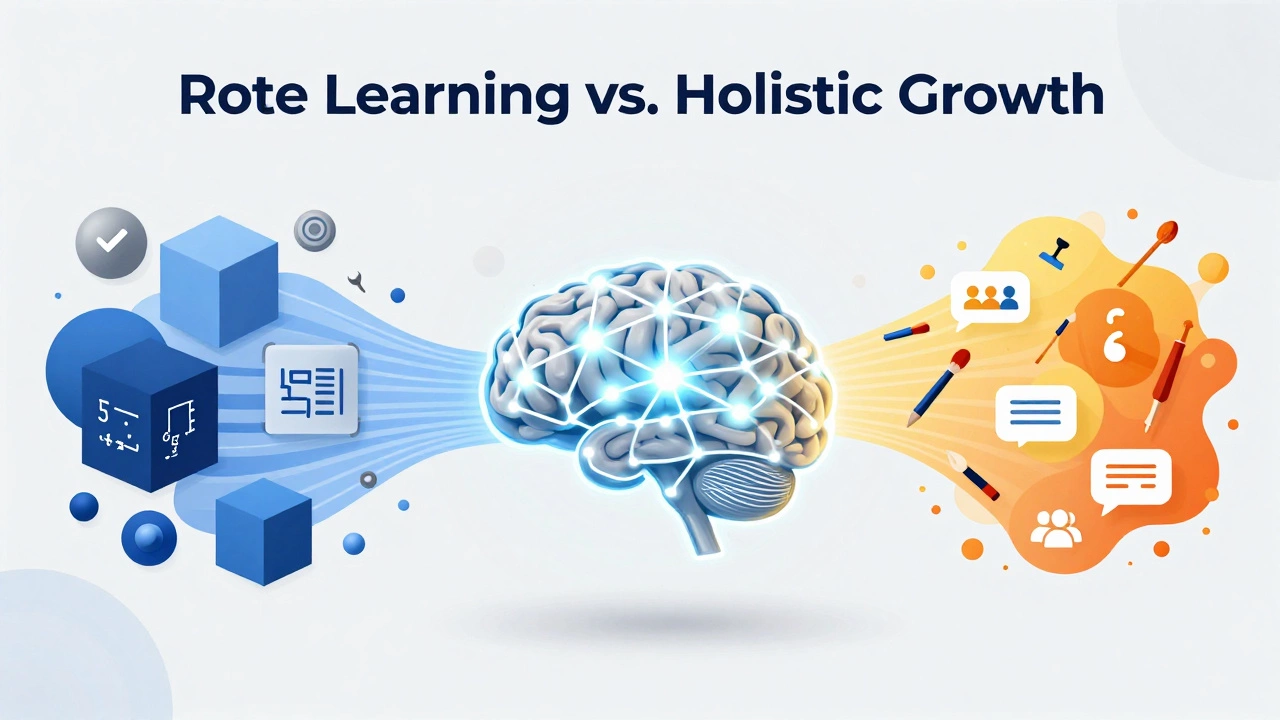
The Core Philosophy: Rote Learning vs. Holistic Growth
The biggest difference isn’t the math problems or the history dates. It’s the goal. The CBSE curriculum is designed to prepare students for highly competitive national entrance exams like JEE and NEET. This means the focus is heavily skewed toward STEM subjects-Science, Technology, Engineering, and Mathematics. If you want to be a doctor or an engineer in India, you don’t just need good grades; you need top-tier scores in specific subjects.
In contrast, the American education system, particularly at the high school level, emphasizes Holistic Development. Colleges care about your GPA, yes, but they also care about your leadership roles, your community service, your sports participation, and your essays. An American student might spend less time memorizing chemical formulas and more time debating ethics in class or leading a robotics club.
This creates two very different types of stress. In the CBSE system, stress is concentrated on academic perfection. One bad test can feel like the end of the world because it impacts your rank. In the US system, stress is diffuse. You have to be good at everything-grades, sports, social life, college applications-which can lead to burnout from trying to maintain a "perfect" image rather than just mastering content.
The Exam Structure: High-Stakes Boards vs. Continuous Assessment
Let’s talk about the exams themselves. This is where the word "hard" usually gets thrown around.
CBSE Exams: The final board exams are massive. They are standardized across the country. For many students, these exams determine their immediate future. The syllabus is vast. You are expected to know every detail of every chapter. There is little room for error. The grading is strict, and the pressure to score above 90% or 95% is intense. Many students take private coaching classes alongside their school studies just to survive this.
American Exams: Grades are calculated continuously throughout the year. Homework, quizzes, midterms, projects, and participation all count toward your final grade. While there are standardized tests like the SAT or ACT, they are just one part of the puzzle. Advanced Placement (AP) courses offer college-level rigor, but even then, the failure rate is lower stakes compared to CBSE boards. If you fail an AP exam, you can retake it next year. If you bomb your CBSE boards, you often have to repeat the entire year or settle for a less prestigious college option.
| Feature | CBSE System (India) | American System (US) |
|---|---|---|
| Primary Goal | Prepare for entrance exams (JEE/NEET) | Holistic college application & skill building |
| Grading Basis | Final Board Exams (High Stakes) | Continuous Assessment + Standardized Tests |
| Subject Focus | Heavy emphasis on Science/Math | Balanced across Arts, Sciences, Electives |
| Classroom Style | Lecture-based, teacher-centered | Discussion-based, student-centered |
| Extracurriculars | Often secondary to academics | Crucial for college admissions |
The Daily Grind: What Does a Student Actually Do?
If you shadow a CBSE student for a day, you’ll see long hours. School might start at 8 AM and end at 3 PM. But the real work begins after that. Many students attend coaching institutes until 7 or 8 PM. Then comes homework, revision, and sleep. Weekends are rarely free; they are filled with mock tests and extra tuition. The volume of content is immense. You are reading textbooks cover to cover.
An American student’s day looks different. School runs from 8 AM to 3 PM as well, but the afternoon is packed with activities. Soccer practice, drama rehearsal, debate club, or part-time jobs. Homework exists, but it’s often project-based or research-oriented rather than repetitive drills. The intellectual challenge in the US comes from critical thinking assignments-writing essays, analyzing literature, solving open-ended science problems-rather than memorizing facts.
So, is CBSE harder? Physically and mentally, the sheer volume of study hours makes CBSE feel heavier. Is American school harder? Intellectually, navigating the ambiguity of essay grading and the pressure to stand out in a crowded applicant pool requires a different kind of resilience.
Depth vs. Breadth: What Are You Actually Learning?
Here is a controversial take: CBSE students often have a deeper foundational knowledge in core subjects like Physics, Chemistry, and Math. Because the syllabus is rigid and comprehensive, a CBSE graduate usually knows their basics cold. They can solve complex equations quickly. This depth is why Indian engineers and doctors are respected globally.
American students, however, often have broader skills. They are taught how to present ideas, how to collaborate in teams, and how to think critically about ethical dilemmas. An American high school graduate might not remember the quadratic formula as instantly as their Indian counterpart, but they might be better equipped to write a persuasive proposal or manage a team project.
This difference becomes clear in university. CBSE students often struggle initially with the lack of structure in Western universities-they are used to being told exactly what to study. American students sometimes struggle with the technical depth required in upper-level STEM courses because their high school education was more generalized.
The Transition Shock: Moving Between Systems
If you are considering moving from one system to the other, expect a culture shock.
Moving from CBSE to the US: You will find the workload lighter at first. You might feel bored because teachers don’t lecture as much. You’ll be asked to speak up in class, which can be terrifying if you’re used to listening quietly. The biggest adjustment is realizing that your grade depends on participation and projects, not just the final exam. You’ll need to learn time management differently-balancing fewer hours of pure study with more hours of social and extracurricular engagement.
Moving from the US to CBSE: You will feel overwhelmed by the volume of content. The pace is faster. The expectation is that you already know the material before it’s taught in class. You’ll need to develop strong memorization techniques and discipline. The classroom environment is more formal, and questioning the teacher directly is less common. You’ll need to adapt to a system where individuality is less celebrated than collective academic achievement.
Which System Is Better for Your Future?
There is no "better" system. There is only the system that fits your goals.
If you want to become a specialist in engineering, medicine, or data science, the CBSE system provides a rigorous foundation that prepares you for the grueling entrance exams required to enter top institutions. It builds mental toughness and deep technical knowledge.
If you are interested in business, arts, law, or entrepreneurship, the American system offers more flexibility. It encourages creativity, public speaking, and networking. It teaches you how to sell yourself and your ideas, which is crucial in non-STEM fields.
Many families now choose hybrid approaches. They keep children in CBSE schools for the academic rigor but supplement with extracurriculars to build a well-rounded profile for international universities. Others send kids to international schools in India that follow IB or American curricula to ease the transition to global higher education.
Common Misconceptions About Difficulty
We need to bust a few myths here.
"American schools are easy." False. Top-tier American high schools are incredibly competitive. The pressure to get into Ivy League colleges is immense. The difference is that the competition is multi-dimensional. You aren’t just competing on test scores; you’re competing on legacy, donations, athletic prowess, and unique talents.
"CBSE students are just rote learners." Outdated. While rote learning is still prevalent, modern CBSE reforms emphasize competency-based assessment. Projects, practical exams, and internal assessments are becoming more important. However, the cultural pressure to memorize remains high due to the nature of the entrance exams.
"You can’t succeed in one system if you come from the other." Absolutely wrong. Thousands of students switch systems every year. With adaptation, both systems produce successful graduates. The key is understanding what each system values and adjusting your strategy accordingly.
Is the CBSE syllabus updated regularly?
Yes, the CBSE syllabus is reviewed and updated periodically to align with global educational standards. Recent changes have focused on reducing rote learning and increasing competency-based questions. However, the core content in science and math remains rigorous and detailed compared to many Western curricula.
Can I use my CBSE marks to apply to US universities?
Absolutely. US universities accept CBSE Class 12 results. However, since the grading scale is different, they often look for context. A 95% in CBSE is considered excellent. You may also need to submit SAT or ACT scores, though many US colleges are currently test-optional. Strong recommendation letters and extracurricular profiles are equally important.
Which system is better for learning English?
The American system generally offers more immersive English language practice through discussion-based classes, presentations, and creative writing. In CBSE, English is a subject studied academically, focusing on grammar, literature analysis, and formal writing. If fluency and conversational confidence are your goals, the US environment provides more natural opportunities for practice.
Do American students study less than CBSE students?
Not necessarily. American students in advanced tracks (like AP or IB) study extensively. However, the *type* of study differs. CBSE students spend more hours on textbook revision and problem-solving. American students spend more time on research, group projects, and extracurricular commitments. The total cognitive load is high in both, but distributed differently.
Is it harder to get into college in India or the US?
Getting into top-tier institutions is extremely difficult in both countries. In India, admission to IITs or AIIMS is based almost entirely on entrance exam ranks, making it a meritocratic but brutal filter. In the US, admission to Ivy League schools involves a holistic review process that includes grades, essays, recommendations, and extracurriculars, adding layers of complexity and subjectivity to the competition.