
JEE Advanced Eligibility & Strategy Calculator
Enter Your Details
Result Title
Description goes here.
Enter your details to check if you qualify for JEE Advanced and receive a tailored study plan.
You have spent years grinding through textbooks, solving endless problem sets, and sacrificing weekends for one goal: securing a seat in an Indian Institute of Technology (IIT). But here is the catch. Getting into an IIT isn't about passing just one test. It requires conquering two distinct hurdles: JEE Main is the first stage of the Joint Entrance Examination conducted by the National Testing Agency (NTA) for admission to NITs, IIITs, and other GFTIs. And then, if you survive that, you face JEE Advanced is the second stage examination conducted by IITs for admission to undergraduate programs at IITs.
Confusion between these two exams costs students dearly every year. Some prepare for JEE Main but fail to qualify for Advanced because they ignored the depth required. Others dive straight into Advanced-level problems and crash out in the preliminary screening. Understanding the structural, conceptual, and strategic differences between these two exams is not optional-it is the foundation of your preparation strategy.
The Core Purpose: Gatekeeper vs. Finalist
To understand the difference, you first need to understand the job each exam does. Think of JEE Main as a wide net. Its primary purpose is screening. The National Testing Agency (NTA) uses it to filter millions of applicants down to a manageable pool. If you score well in JEE Main, you earn two things: eligibility to sit for JEE Advanced, and direct admission opportunities to National Institutes of Technology (NITs), Indian Institutes of Information Technology (IIITs), and other Government Funded Technical Institutions (GFTIs).
JEE Advanced, on the other hand, is a precision instrument. Conducted by a rotating committee of IITs, its sole purpose is to identify the top percentile of candidates who possess the analytical depth required for IIT education. You cannot get into an IIT with only a JEE Main score. You must clear both. This two-tier system ensures that IITs select students who are not just good at memorizing formulas, but exceptional at applying them under pressure.
| Feature | JEE Main | JEE Advanced |
|---|---|---|
| Conducting Body | National Testing Agency (NTA) | Rotating IIT Committee |
| Primary Goal | Screening & NIT/IIIT Admission | IIT Admission Only |
| Exam Frequency | Multiple sessions (usually 4-6) per year | Single attempt per year |
| Difficulty Level | Moderate to High (Speed-focused) | Very High (Depth-focused) |
| Question Type | MCQs & Numerical Value Questions | MCQs, Integer Type, Multiple Correct, Matrix Match |
| Syllabus Scope | Strictly Class 11 & 12 NCERT/CBSE | Class 11 & 12 + Extended Concepts |
Eligibility: The Crucial Link
This is where most students make their first mistake. They assume that scoring high in JEE Main automatically guarantees a spot in JEE Advanced. It does not. There is a strict cutoff mechanism.
To be eligible for JEE Advanced, you must rank within the top 2.5 lakh candidates in JEE Main. For General category students, this usually means securing an All India Rank (AIR) under approximately 250,000. For reserved categories (OBC-NCL, SC, ST, PwD), the cutoff ranks are higher (relaxed), typically around 37,500, 18,750, and 9,375 respectively. These numbers fluctuate slightly based on the difficulty of the paper and the number of applicants, but the 2.5 lakh threshold for General category remains the golden rule.
If you miss this cutoff by even one rank, you are barred from taking JEE Advanced that year. You can still use your JEE Main score to get into NITs or IIITs, but the door to IITs slams shut until the next cycle. This makes JEE Main not just an end in itself, but a mandatory gateway.
Exam Pattern: Speed vs. Complexity
The structure of the papers reflects their different goals. JEE Main is designed to test breadth and speed. You have three subjects-Physics, Chemistry, and Mathematics-with 30 questions each (90 total). The time limit is 3 hours. The questions are largely single-correct multiple-choice questions (MCQs) and numerical value questions. The key challenge here is accuracy under time pressure. You don't need to spend 10 minutes on a single question; you need to solve standard problems quickly.
JEE Advanced flips this script. The exam consists of two separate papers, each lasting 3 hours. The total duration is 6 hours, spread over two days. The question types are far more diverse and punishing. You will encounter:
- Multiple Correct Options: Where one wrong selection leads to negative marking.
- Integer Type: Where you must calculate an exact integer answer without options to guide you.
- Matrix Match / Paragraph Based: Complex scenarios requiring multi-step logical deduction.
- Variable Negative Marking: Unlike JEE Main's uniform -1 penalty, JEE Advanced may have partial credit or zero negative marking depending on the specific question type defined for that year.
In JEE Main, you can often guess or eliminate options. In JEE Advanced, guessing is a dangerous game. The questions often combine concepts from different chapters-for example, mixing Rotational Motion with Conservation of Momentum in Physics, or combining Organic Reaction Mechanisms with Isomerism in Chemistry.

Syllabus Depth: NCERT vs. Beyond
For JEE Main, sticking to the NCERT textbooks for Class 11 and 12 is often sufficient, especially for Chemistry. The questions are directly aligned with the CBSE board syllabus. While you need reference books for practice, the core concepts rarely deviate from what is taught in standard classrooms.
JEE Advanced demands a deeper understanding. While the official syllabus states it covers Class 11 and 12 topics, the application goes beyond textbook examples. You need to master advanced problem-solving techniques. For instance, in Mathematics, JEE Main might ask you to find the derivative of a function. JEE Advanced might ask you to apply that derivative to optimize a complex real-world scenario involving constraints and inequalities. In Physics, you move from simple kinematics to complex systems involving variable mass or non-inertial frames.
If you rely solely on NCERT for JEE Advanced preparation, you will likely struggle. You need resources that challenge your conceptual clarity and expose you to unconventional problem statements.
Scoring and Ranking: How Your Seat is Decided
The ranking systems differ significantly. For JEE Main, the NTA calculates a normalized score across all sessions. Since there are multiple attempts, your best score is considered. The final rank is purely based on this normalized score. This rank determines your admission to NITs, IIITs, and GFTIs through the CSAB counseling process.
For JEE Advanced, the ranking is based on your performance in Paper 1 and Paper 2. The scores from both papers are combined to create a composite score. This composite score determines your All India Rank (AIR) for IIT admissions. Importantly, JEE Advanced ranks are independent of JEE Main ranks. A student with AIR 100 in JEE Main could have AIR 10,000 in JEE Advanced if they perform poorly in the second stage. Conversely, a moderate JEE Main performer who excels in Advanced can secure a top IIT seat.
Admission to IITs is done through JoSAA (Joint Seat Allocation Authority) counseling, which uses your JEE Advanced rank. Admission to NITs/IIITs is done through CSAB or JoSAA using your JEE Main rank. You cannot mix and match these ranks.
Strategic Approach: Preparing for Both Simultaneously
Most serious aspirants prepare for both exams simultaneously. This is possible because the foundational syllabus is the same. However, your daily routine needs to balance two conflicting skills: speed and depth.
Here is a practical framework:
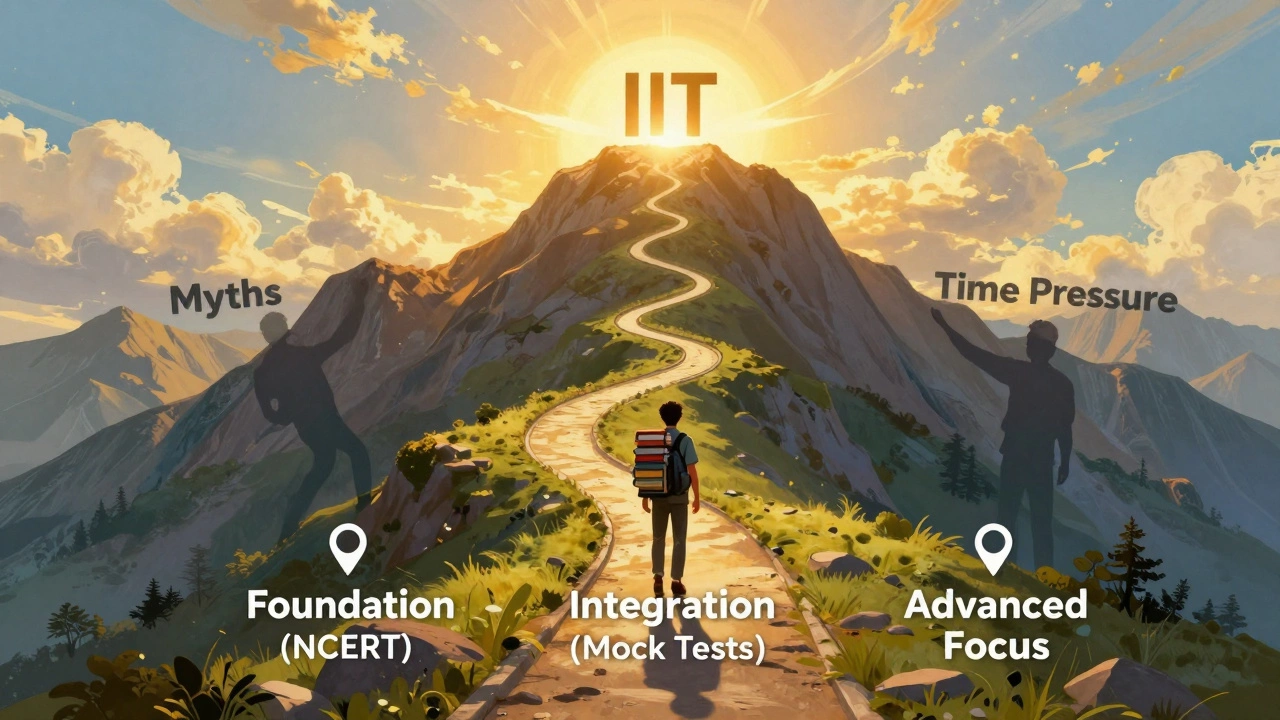
- Foundation Phase (Months 1-6): Focus on building strong concepts. Solve NCERT thoroughly. Use standard reference books like HC Verma for Physics and RD Sharma for Mathematics. At this stage, do not worry about JEE Advanced level tricks. Master the basics.
- Integration Phase (Months 7-12): Start solving mixed-topic problems. Take mock tests for JEE Main to build speed. Aim for consistent scores above the 95th percentile. Begin introducing JEE Advanced level problems in small doses-perhaps 5-10 questions per week.
- Advanced Focus Phase (After JEE Main): Once JEE Main is over, shift 100% of your energy to JEE Advanced. Analyze previous years' JEE Advanced papers (last 10 years). Understand the pattern of tricky questions. Practice full-length mock tests under strict exam conditions.
A common pitfall is neglecting JEE Main while focusing on Advanced. Remember, if you don't clear the JEE Main cutoff, your brilliant JEE Advanced preparation becomes useless. Always ensure your JEE Main score is safe before diving too deep into Advanced complexities.
Common Myths Debunked
Myth 1: JEE Advanced is just harder JEE Main.
False. JEE Main tests how fast you know the syllabus. JEE Advanced tests how deeply you understand it. A student who can solve JEE Main quickly might fail JEE Advanced if they lack conceptual flexibility.
Myth 2: You need coaching for JEE Advanced.
Not necessarily. While coaching provides structure, self-study with the right resources (like previous year papers and standard advanced texts) can be equally effective. Discipline is more important than the classroom.
Myth 3: Chemistry is less important in JEE Advanced.
Dangerous assumption. In JEE Advanced, Chemistry often acts as the rank decider. Many students focus heavily on Physics and Math, leaving Chemistry for last-minute cramming. This backfires because Advanced Chemistry questions require deep mechanistic understanding, not rote memory.
Can I get into an IIT with only JEE Main?
No. JEE Main scores are used for admission to NITs, IIITs, and other GFTIs. To get into any IIT, you must qualify for and take JEE Advanced. Your final IIT admission rank is determined solely by your JEE Advanced performance.
What is the cutoff rank for JEE Advanced?
You must be in the top 2.5 lakh candidates in JEE Main to be eligible for JEE Advanced. For General category students, this typically means an All India Rank (AIR) below 250,000. Cutoffs for reserved categories are relaxed proportionally.
Is the syllabus for JEE Main and JEE Advanced the same?
Officially, yes. Both cover Class 11 and 12 Physics, Chemistry, and Mathematics. However, the depth and complexity of questions in JEE Advanced go beyond standard textbook problems, requiring a deeper conceptual understanding and ability to integrate multiple topics.
How many times can I appear for JEE Main?
The NTA conducts JEE Main multiple times a year (usually 4-6 sessions). You can appear for all of them, and your best normalized score will be considered for your final rank. JEE Advanced, however, is a single-attempt exam held once a year.
Which exam is more difficult?
JEE Advanced is significantly more difficult. It features complex, multi-concept questions, varied question types (like matrix matches and integer types), and a higher demand for analytical reasoning. JEE Main is challenging due to its length and speed requirements, but the concepts are generally more straightforward.