English Skills Balanced Planner
Your Personalized Strategy
60 Minutes TotalQuick Wins for Your English Journey
- Listening: Move from passive hearing to active decoding using podcasts and shadows.
- Speaking: Focus on flow and muscle memory over perfect grammar.
- Reading: Switch to "comprehensible input"-material just slightly above your current level.
- Writing: Build a daily habit of output, starting with journals or short social posts.
The Art of Listening: Training Your Ears
Most learners struggle with speaking not because they don't know the words, but because they can't hear the boundaries between words. In English, we use something called connected speech. For example, "What do you do?" often sounds like "Whadyu do?" If you are listening for individual words, you'll get lost.
Listening is a receptive skill that involves processing auditory input to derive meaning. It is the foundation of all language acquisition; you cannot produce sounds you haven't first internalized.
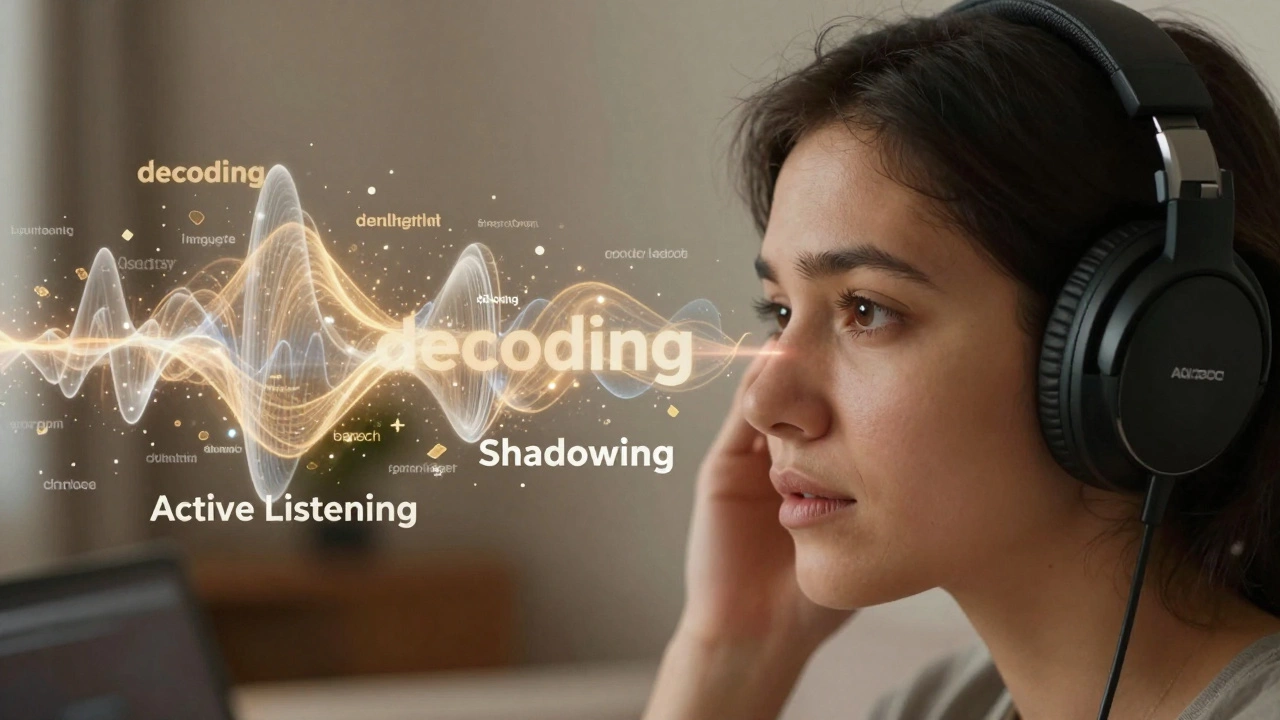
To get better, stop just "playing English in the background." That's passive and doesn't do much. Instead, try Active Listening. Find a 30-second clip of a native speaker. Listen once for the general idea. Listen a second time and write down every single word you hear. This forces your brain to notice the small "function words" like of, the, and at that usually disappear in fast speech.
Another powerful tool is Shadowing, which is a technique where you repeat a speaker's words immediately after they say them, mimicking their speed and intonation. It's like singing along to a song, but with a conversation. This bridges the gap between hearing a sound and being able to make it yourself.
Speaking: Breaking the Fear Barrier
Speaking is the most stressful part of improve English efforts because it happens in real-time. There is no "undo" button. The biggest mistake people make is waiting until their grammar is perfect before they start talking. Newsflash: your grammar will never feel "perfect" until you start making mistakes out loud.
Speaking is a productive skill that requires the physical coordination of speech organs and the mental speed to retrieve vocabulary. It is often the last skill to develop because it requires the highest level of confidence.
If you don't have a speaking partner, talk to yourself. Describe your day as you do things. "I am opening the fridge now. I'm looking for the eggs." It sounds silly, but it builds the neural pathways between your thoughts and your mouth. When you do get into a real conversation, focus on communication over perfection. If you say "I go to store yesterday" instead of "I went to the store yesterday," the other person still knows exactly what you mean. The flow is more important than the tense in 90% of casual interactions.
| Skill Type | Examples | Mental Process | Difficulty Level |
|---|---|---|---|
| Receptive (Input) | Listening, Reading | Decoding & Recognition | Easier |
| Productive (Output) | Speaking, Writing | Retrieval & Construction | Harder |
Reading: Expanding Your Mental Dictionary
Reading is how you encounter the "natural" version of the language. Textbooks often teach you a formal version of English that no one actually uses. To avoid sounding like a 19th-century lawyer, you need to read things that people actually write today.
Reading is the process of interpreting written symbols to extract meaning, which significantly expands a learner's vocabulary and grasp of syntax. It allows the learner to see how grammar works in context without the pressure of a ticking clock.
The secret here is Comprehensible Input. This is a concept from linguistics that suggests you should read material where you understand about 70-80% of the content. If you try to read a medical journal but only know basic English, you'll spend all your time in a dictionary and get bored. If you read a children's book, you won't learn anything new. Aim for the "sweet spot"-like a blog post about a hobby you love or a young adult novel. When you encounter a new word, don't look it up immediately. Try to guess the meaning from the rest of the sentence. This "guessing game" is actually when the most learning happens.
Writing: The Laboratory of Language
Writing is where you can slow everything down. If speaking is a sprint, writing is a long walk. It's the place where you can experiment with that fancy new word you found in a book or try out a complex sentence structure to see if it actually makes sense.
Writing is the physical manifestation of language through text, serving as a tool for organizing thoughts and refining grammatical accuracy. It converts passive knowledge into active skill.
Start a micro-journal. Instead of writing a full page, write three sentences every night: one thing that happened, one thing you felt, and one thing you want to do tomorrow. To take it to the next level, use a tool like a grammar checker, but don't just click "correct all." Look at why the mistake happened. Did you confuse your and you're? Did you forget the -s on a third-person singular verb? Once you spot the pattern, you'll stop making that mistake when you speak.
Connecting the Dots: The Integrated Approach
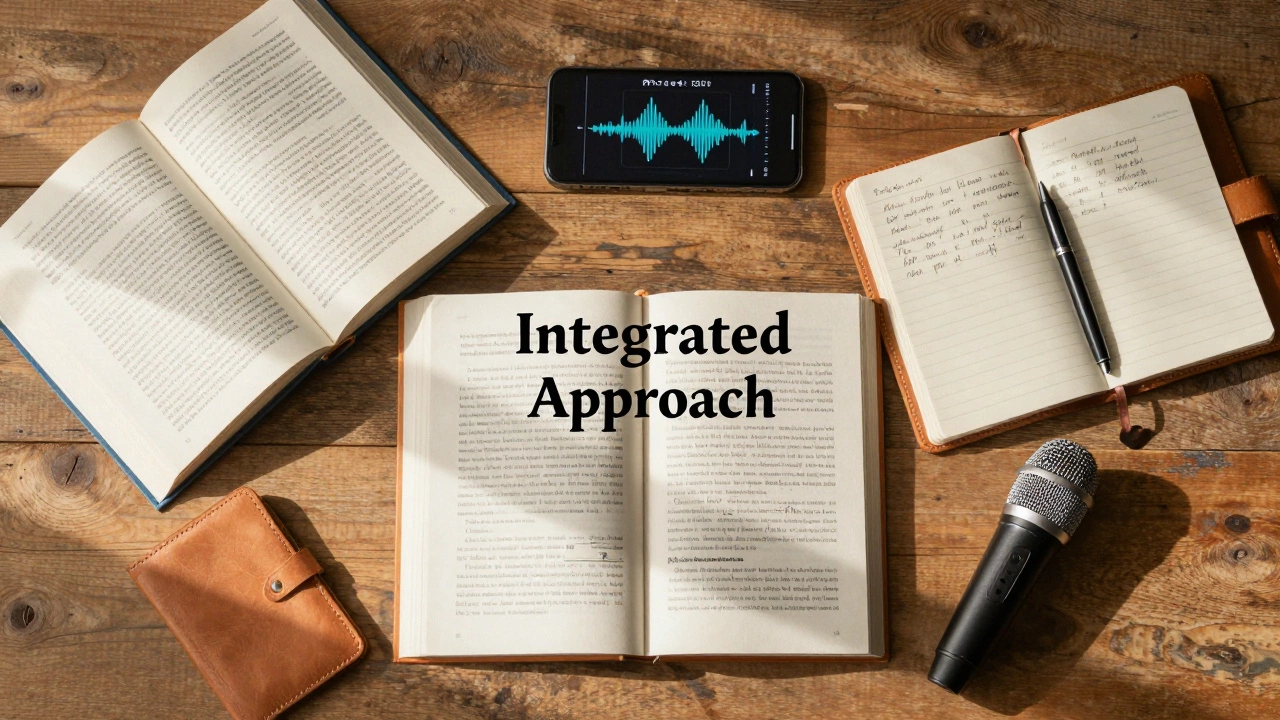
The real magic happens when you combine these skills. They shouldn't exist in silos. If you read an article about climate change, your next step should be to write a summary of it, then find a podcast on the same topic, and finally record yourself talking about your opinion on it. This creates a "feedback loop" in your brain.
For example, if you're taking English speaking courses, don't just do the speaking exercises. Read the transcript of the lesson first (Reading), listen to the audio (Listening), write a response to the prompt (Writing), and then say it out loud (Speaking). This 360-degree approach is how polyglots learn languages so quickly; they don't just study the language, they live it through all four channels.
One common pitfall is the "Plateau Effect," where you feel like you've stopped improving after reaching an intermediate level. This usually happens because you're staying in your comfort zone. To break through, increase the difficulty of your input. Switch from a graded reader to a real newspaper, or from a slow-paced podcast to a fast-paced debate. The discomfort you feel is actually the sound of your brain growing.
Which of the 4 skills is the most important to start with?
Listening is the best place to start. Just like a baby learns their first language, you need to absorb the sounds and rhythms of English before you can possibly produce them. Without a strong listening foundation, your speaking will sound robotic or unnatural.
How can I improve my speaking if I have no one to talk to?
Use the Shadowing technique: listen to a native speaker and mimic them exactly, including their emotion and speed. Additionally, record yourself on your phone, listen back to it, and compare it to the original audio to find where your pronunciation differs.
How much time should I spend on each skill daily?
It depends on your goal, but a balanced split is usually best. Try 30 minutes of input (Reading/Listening) and 30 minutes of output (Writing/Speaking). If you're preparing for a job interview, tilt the balance more toward speaking and listening.
Does reading a lot actually help me speak better?
Yes, but only if it's the right kind of reading. Reading formal books helps with grammar and vocabulary, but reading scripts, blogs, or social media helps you understand how people actually talk, which directly improves your conversational speaking.
Why is writing considered a 'laboratory' for speaking?
Writing allows you to process the language without the time pressure of a conversation. You can look up the perfect word, check the grammar, and organize your thoughts. Once you've "solved" the sentence in writing, your brain finds it much easier to produce that same structure during a live conversation.
Next Steps for Your Progress
Depending on where you are right now, your focus should shift. If you're a beginner, spend 70% of your time on Listening and Reading to build your base. If you're intermediate, start pushing your output with Writing and Speaking, even if it's scary. If you're advanced, focus on the nuances-idioms, cultural references, and professional jargon.
If you hit a wall, try changing your medium. Bored with textbooks? Watch a sitcom. Tired of podcasts? Read a comic book. The most important part of improving your English is staying curious and keeping the process interesting. If it feels like a chore, you'll quit. If it feels like a game, you'll master it.