JEE Main Syllabus: What’s Included and How to Master It
When you’re preparing for the JEE Main syllabus, the official curriculum for India’s primary engineering entrance exam, used by over 1.5 million students annually to qualify for NITs, IIITs, and other CFTIs. Also known as Joint Entrance Examination Main, it’s not just a list of topics—it’s the roadmap to your engineering future. Unlike school exams, JEE Main doesn’t test memory. It tests how well you can apply concepts under pressure, especially in Mathematics, Physics, the study of motion, energy, and forces, which forms the core of engineering problem-solving, and Chemistry, split into physical, organic, and inorganic sections, each demanding a different kind of thinking.
The syllabus is broad, but not random. It’s built around Class 11 and 12 CBSE content, but goes deeper. For example, in Physics, you won’t just learn Newton’s laws—you’ll need to solve multi-step problems involving pulleys, springs, and rotating systems. In Math, calculus isn’t just about integration formulas; you’ll need to visualize graphs, find areas under curves, and apply differential equations to real-world scenarios. Chemistry’s organic section isn’t memorizing reactions—it’s understanding mechanisms, electron flow, and stereochemistry. The exam is designed to separate those who practice from those who just read. And that’s why students who focus on IIT JEE, the more advanced version of JEE Main, used for admission to the Indian Institutes of Technology often find JEE Main easier—because they’ve trained at a higher level.
What’s missing from the syllabus? Fluff. No vague theory. No essay questions. Every question is precise, timed, and scored. That’s why top scorers don’t try to cover everything—they master the high-yield topics. For instance, in Math, topics like Coordinate Geometry and Algebra make up nearly 40% of the paper. In Physics, Electrodynamics and Mechanics are non-negotiable. In Chemistry, Organic reactions and Chemical Bonding are your best friends. The syllabus doesn’t change much year to year, but the way questions are framed does. That’s why practicing past papers isn’t optional—it’s your training ground.
You’ll find posts here that break down which subject gives you the most marks, how to study for JEE Main while balancing board exams, and why some students crush Math but struggle with Chemistry. There’s no magic trick. It’s about smart focus, consistent practice, and knowing exactly where to put your time. What follows isn’t just a list of articles—it’s a collection of real strategies used by students who cracked the exam. Read them. Apply them. Move forward.
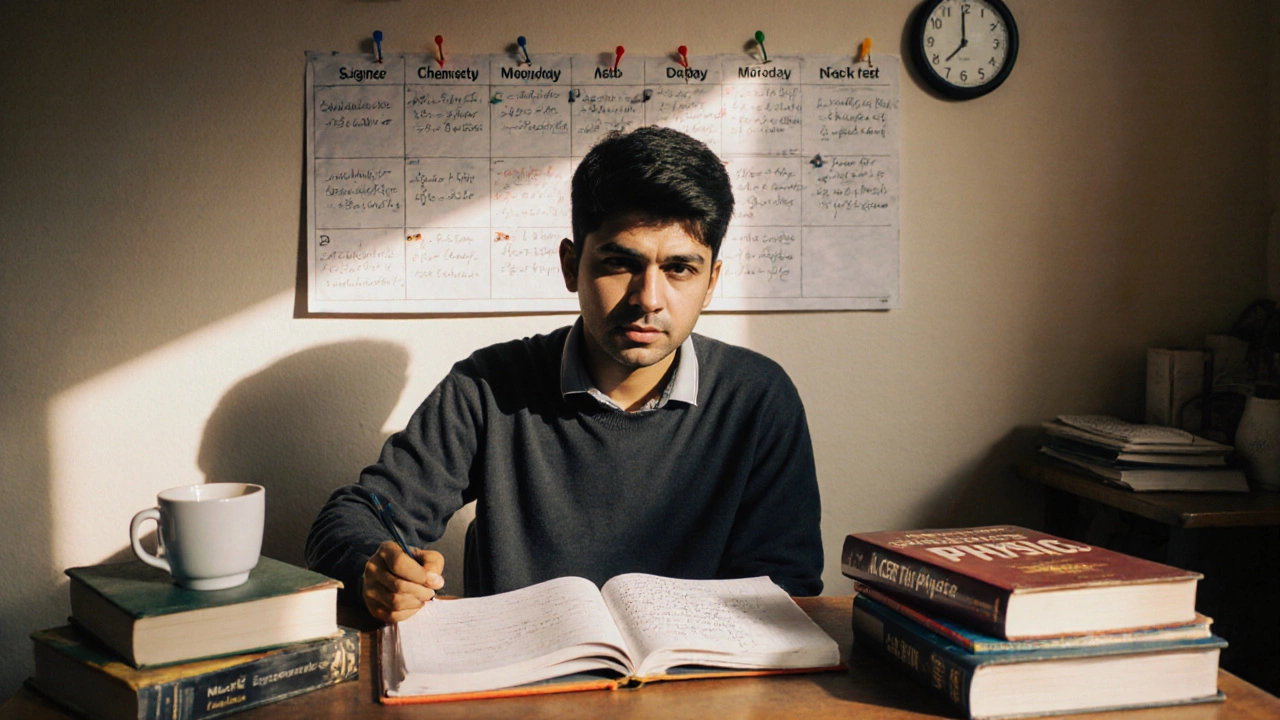
Learn how to start preparing for IIT JEE with a practical, step-by-step plan that focuses on consistency, smart study habits, and exam strategy. Avoid common mistakes and build a winning routine from Class 11.