Education Path Finder
Answer these questions to determine which study mode fits your current life stage best.
Recommendation
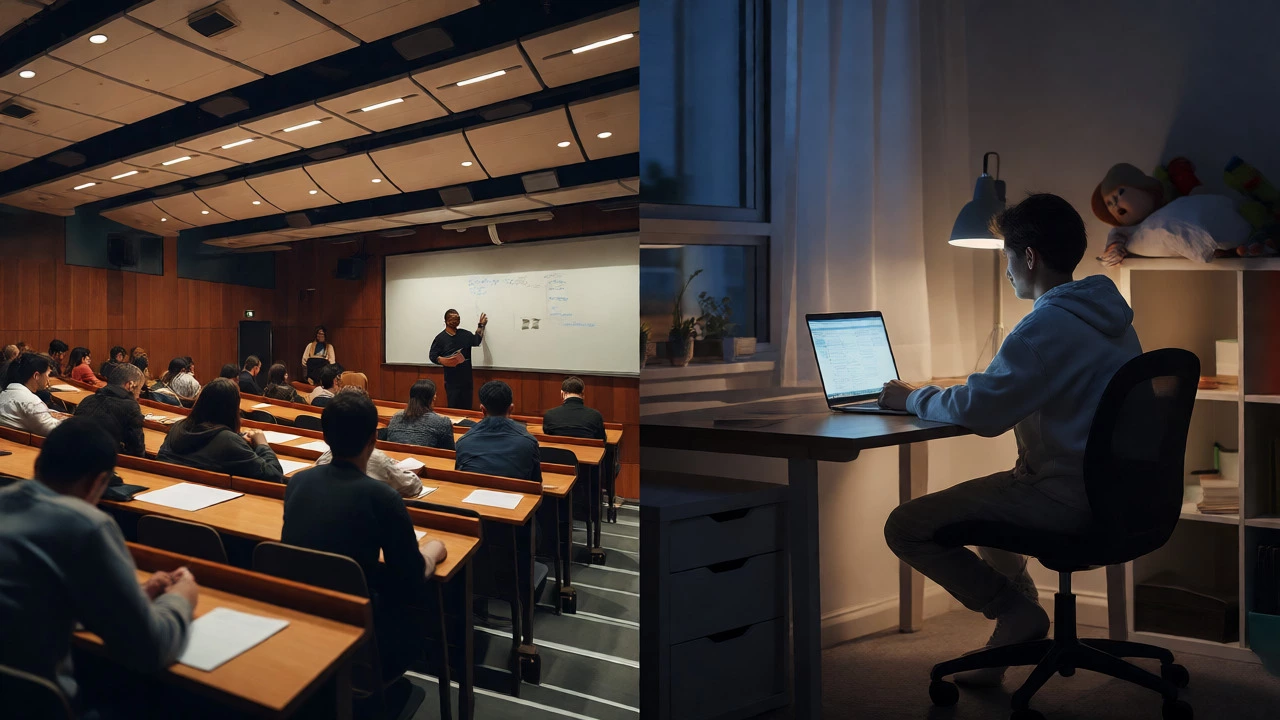
Imagine you are sitting in a lecture hall in Sydney. The air conditioning hums, the professor’s voice echoes slightly off the back wall, and you are trying to focus while your phone buzzes with notifications. Now, imagine that same lecture happening on your laptop screen at 10 PM, after you’ve put the kids to bed, with the only sound being the click of your mouse. This is the core tension between traditional education and distance education. One relies on physical presence and synchronous timing; the other leverages technology to decouple learning from place and time.
For decades, the brick-and-mortar model was the default. If you wanted a degree, you went to campus. Today, that rule has shattered. With over 6 million students enrolled in higher education institutions across Australia alone, and a significant portion opting for flexible study modes, understanding the real-world differences between these two systems isn’t just academic-it’s a career decision. Are you choosing based on prestige? On convenience? Or on how well the format matches your brain’s ability to absorb information?
The Core Structural Difference: Synchronous vs Asynchronous
The most immediate difference people feel is time control. In traditional education, learning is typically synchronous. You must be in class at 9 AM on Monday. If you miss it, you rely on notes or recordings, but the live interaction-the Q&A, the debate-is gone. It creates a rigid schedule that works brilliantly for some but fails miserably for others who need to work full-time or manage family responsibilities.
Distance education, often utilizes asynchronous learning models. Here, the content is delivered via platforms like Moodle, Blackboard, or Canvas. You watch the lecture when you can. You submit the assignment before the deadline, not necessarily during a specific hour. This flexibility is the primary selling point. However, it demands a different kind of discipline. Without a teacher physically watching you, procrastination becomes your biggest enemy. Studies consistently show that completion rates in fully online courses can be lower than in face-to-face settings, largely because self-motivation is harder to sustain than external pressure.
Social Interaction and Networking
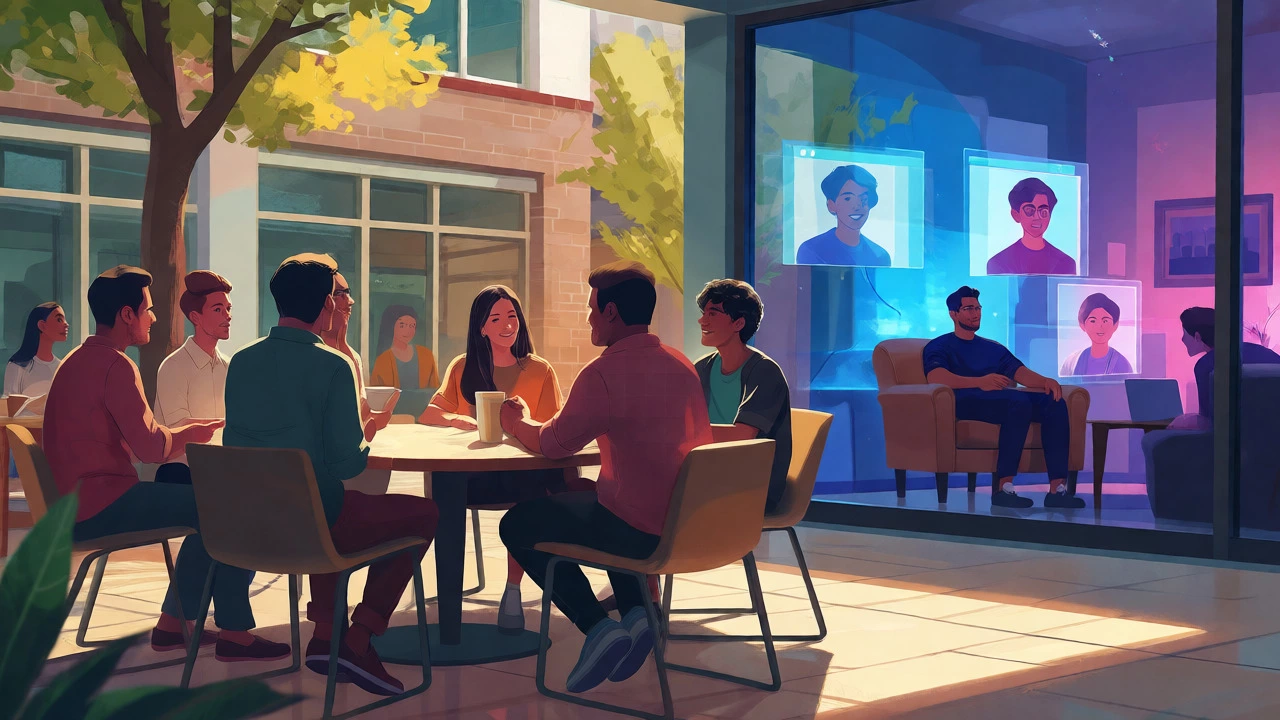
Let’s talk about the human element. A common critique of distance learning is isolation. In a traditional classroom, social capital is built through hallway chats, group projects formed by proximity, and informal networking with peers who might become future colleagues. These "weak ties" are often where job opportunities emerge.
In distance education, this dynamic shifts. You don’t bump into classmates; you join them in discussion forums or Zoom breakout rooms. While this can feel sterile initially, it changes the nature of interaction. Online discussions allow introverts more time to formulate thoughts, leading to deeper, more thoughtful contributions rather than quick, reactive remarks. However, building genuine professional networks requires proactive effort. You have to reach out. You have to attend virtual office hours. You have to engage in peer review activities deliberately. The network exists, but it doesn’t happen by accident.
| Feature | Traditional Education | Distance Education |
|---|---|---|
| Schedule Flexibility | Low (Fixed class times) | High (Self-paced or flexible) |
| Location Requirement | On-campus attendance required | Anywhere with internet access |
| Cost Structure | Tuition + Commuting + Housing | Tuition + Technology fees (no commute/housing) |
| Learning Style | Lecture-driven, immediate feedback | Self-directed, delayed feedback loops |
| Social Interaction | High, spontaneous, in-person | Moderate, structured, digital |
Cost Implications and Accessibility
Money matters. When we compare costs, we aren’t just looking at tuition fees. We’re looking at the total cost of ownership. For traditional students, especially those studying away from home, housing and food are massive line items. In cities like Sydney or Melbourne, renting near a university campus can cost thousands per month. Add in commuting costs-whether public transport fares or fuel-and the price tag climbs steeply.
Distance education eliminates these overheads. You save on rent, travel, and often even textbooks if they are provided digitally. Many universities offer the same tuition rates for online and on-campus degrees, meaning the savings come entirely from lifestyle adjustments. For working professionals, this is a game-changer. You don’t have to quit your job to study, which means you maintain your income stream. Over four years, avoiding lost wages can outweigh any minor differences in tuition fees. However, be wary of hidden tech costs. Reliable high-speed internet, a decent computer, and software licenses are prerequisites, not extras.

Learning Outcomes and Skill Development
Does one method produce better graduates? Research suggests that student outcomes depend less on the medium and more on the design of the course. A poorly taught online class will fail just as spectacularly as a boring lecture hall session. But there are distinct skill sets developed in each environment.
Traditional environments excel at teaching soft skills in real-time. Reading body language, managing group dynamics, and thinking on your feet are honed through direct human contact. Employers often value this because it translates directly to office culture.
Conversely, distance education forces you to master digital literacy and self-management. You learn to navigate complex Learning Management Systems (LMS), manage your own deadlines without nagging, and communicate effectively in written formats. In today’s remote-work-heavy economy, these are highly marketable skills. Being able to articulate an idea clearly in a Slack message or an email thread is often more valuable than being the loudest voice in a meeting room.
Which Path Fits Your Life Stage?
So, how do you choose? There is no universal "better." It depends on your current constraints and goals.
- Choose Traditional if: You thrive on structure, need immediate instructor feedback, value the social experience of campus life, or are pursuing fields requiring heavy lab work or clinical practice (like nursing or engineering) where hands-on training is non-negotiable.
- Choose Distance if: You are balancing work and study, live far from major educational hubs, prefer self-paced learning, or want to minimize financial burden. It’s also ideal for upskilling in tech or business areas where theoretical knowledge can be applied remotely.
Hybrid models are also gaining traction. Many Australian universities now offer blended degrees, allowing you to attend intensive weekend workshops or short residential blocks while doing the bulk of the theory online. This offers the best of both worlds: the networking benefits of face-to-face interaction with the flexibility of remote study.
Is a distance education degree respected by employers?
Yes, generally. Accredited universities issue the same diploma regardless of whether you studied online or on-campus. Employers increasingly recognize that distance learners possess strong time-management and digital communication skills. The key is ensuring the institution itself is accredited and reputable.
Do distance education students get less support?
Not necessarily, but the mode of delivery differs. Instead of walking into an office hours queue, you use email, chat functions, or scheduled video calls. Support services like libraries and counseling are often available virtually. Success depends on your willingness to utilize these digital channels proactively.
Can I switch from traditional to distance education mid-degree?
Many universities allow this, but policies vary. Some programs require a minimum number of credits to be completed on-campus, particularly for practical subjects. Check with your registrar early, as switching may affect your visa status if you are an international student.
What is the biggest challenge in distance education?
Self-discipline and isolation. Without the external structure of fixed class times, procrastination can creep in. Additionally, the lack of casual social interaction can lead to feelings of disconnect. Creating a routine and actively engaging in online communities helps mitigate these issues.
Are online exams secure?
Institutions use various methods to ensure integrity, including timed assessments, randomized question banks, plagiarism detection software, and sometimes proctoring software that monitors webcam activity. While not perfect, these measures have improved significantly in recent years.