2026 Career Path Estimator
Data Science
Top GrowthCybersecurity
High DemandNursing (BSN)
StableSoftware Engineering
VersatileRenewable Energy
Future-ProofEstimated Career Outlook
Degree Name
Based on 2026 market trends
Projected Annual Salary
$0 - $0
Base + BonusJob Growth Rate (5-Year)
0%
Market TrendKey Skills to Master
...
Pro Tip for 2026
...
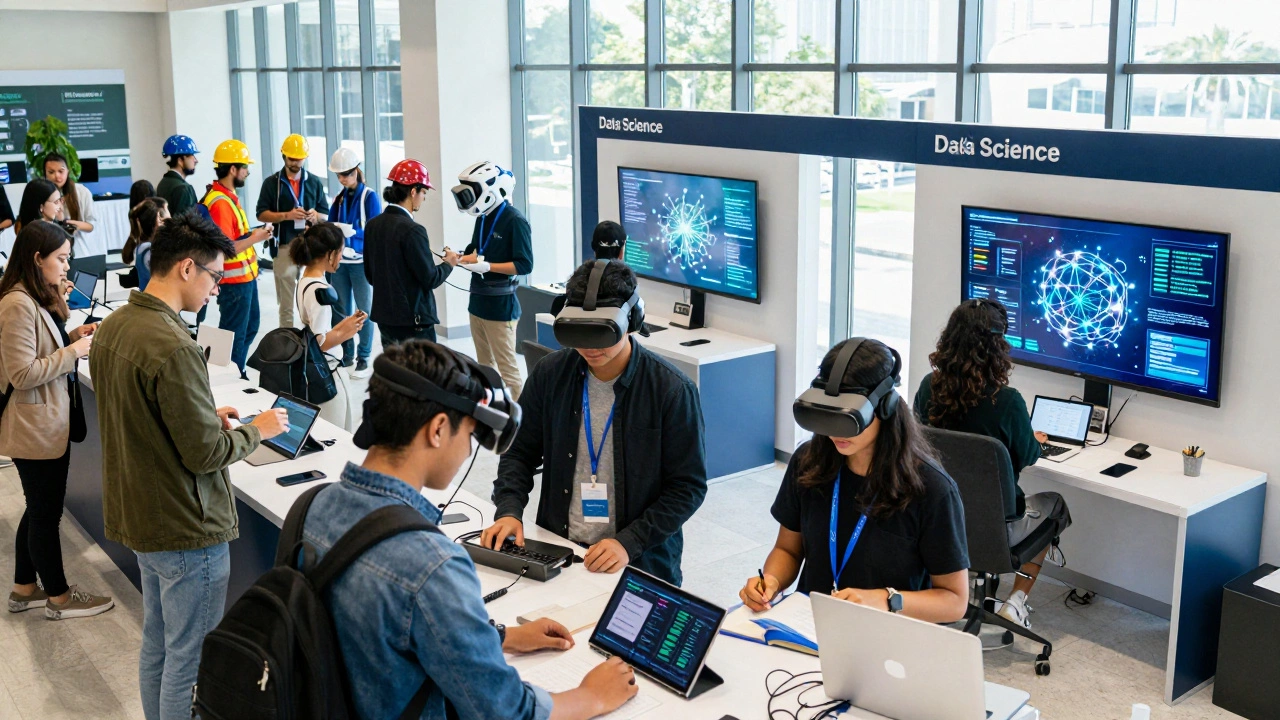
Walking into a university career fair in early 2026 feels different than it did five years ago. The booths forklifts and construction hard hats are still there, but they share the floor with VR headsets and AI ethics consultants. You look around and wonder: What am I actually signing up for? If you are choosing a major right now, you aren't just picking a subject you like. You are betting on which industries will still be hiring when you graduate in three or four years.
The short answer to "what degree is most in demand" isn't a single word. It’s a cluster of fields where technology meets human judgment. But if we have to pick the absolute hottest ticket in town, it’s Data Science. However, that’s only part of the story. Let’s break down the real landscape of high-demand degrees in 2026, looking at salary potential, job security, and how automation is reshaping these roles.
The Data Dominance: Why Data Science Leads the Pack
In 2026, data is no longer just a byproduct of business; it is the primary asset. Companies don’t just want to store information; they want to predict behavior, optimize supply chains, and personalize user experiences in real-time. This shift has made Data Science, defined as the interdisciplinary field that uses scientific methods, processes, algorithms, and systems to extract knowledge and insights from structured and unstructured data, the gold standard for STEM graduates.
Why is this degree so dominant? Because almost every industry needs it. Healthcare providers use data scientists to predict patient outbreaks. Retail giants use them to manage inventory before a trend even peaks. Even creative agencies rely on data analytics to understand audience engagement. A Bachelor’s or Master’s in Data Science opens doors to roles like Machine Learning Engineer, Business Intelligence Analyst, and Data Architect.
The barrier to entry has risen, though. It’s not enough to know Excel anymore. Employers expect proficiency in Python or R, experience with SQL databases, and an understanding of statistical modeling. If you enjoy solving puzzles and have a knack for statistics, this path offers some of the highest starting salaries in the market, often exceeding $90,000 USD annually for entry-level positions in tech hubs.
Cybersecurity: The Non-Negotiable Shield
If Data Science is the engine, Cybersecurity is the brake system. As our world becomes more digitized, the threat landscape expands exponentially. With the rise of quantum computing threats and sophisticated AI-driven cyberattacks, companies are desperate for professionals who can protect their digital infrastructure.
A degree in Cybersecurity, Information Security, or Network Defense is consistently one of the most requested credentials by employers. Unlike some tech roles that fluctuate with economic cycles, security is recession-proof. When money is tight, companies cut marketing budgets first, not their security teams. One breach can cost millions, so prevention is always prioritized.
Key roles include Security Analyst, Penetration Tester (ethical hacker), and Chief Information Security Officer (CISO). The work is high-pressure but incredibly rewarding. You are essentially playing cat-and-mouse with criminals trying to steal identities, intellectual property, and financial data. Certifications like CISSP or CEH complement your degree, making you even more employable.
Healthcare and Nursing: The Human Touch That Can’t Be Automated
While robots might diagnose diseases using AI, they cannot yet hold a patient’s hand or navigate the complex emotional dynamics of care. The global population is aging, particularly in developed nations like the US, Japan, and parts of Europe. This demographic shift creates a massive, sustained demand for healthcare workers.
Nursing, specifically the practice of caring for individuals, families, and communities to maintain and restore health at the highest level of competence, remains one of the most stable careers available. Registered Nurses (RNs) and Nurse Practitioners (NPs) are in short supply worldwide. Hospitals are offering sign-on bonuses and tuition reimbursement because they simply cannot find enough qualified staff.
Beyond nursing, degrees in Physical Therapy, Occupational Therapy, and Physician Assistant studies are booming. These roles require significant clinical hours and rigorous licensing exams, but the job security is unmatched. You will likely never worry about unemployment in this field. The trade-off is the emotional toll and the physical demands of the job, but for many, the ability to help people directly makes it worth it.

Software Engineering: Still King, But Evolving
Did coding die? No. It evolved. There was a lot of noise in 2023-2024 about AI writing code better than humans. While tools like GitHub Copilot have changed *how* we code, they haven’t replaced the need for architects who understand system design, scalability, and logic. Software Engineering is still a top-tier degree, but the focus has shifted from syntax memorization to problem-solving and integration.
Employers are looking for engineers who can build robust applications, integrate AI models into existing products, and ensure software reliability. Full-stack development, cloud computing (AWS, Azure, Google Cloud), and DevOps practices are highly valued. A Computer Science or Software Engineering degree provides the theoretical foundation needed to adapt to whatever new programming language or framework emerges next year.
The key here is specialization. Generalist coders face more competition. Specialists in embedded systems, blockchain architecture, or mobile app development find themselves in higher demand. If you love building things from scratch and enjoy logical challenges, this remains a fantastic choice.
Renewable Energy and Environmental Science
Climate change is no longer a distant threat; it’s a current crisis driving policy and investment. Governments globally are pouring billions into green energy initiatives. This has created a surge in demand for engineers and scientists who can design sustainable solutions.
Degrees in Renewable Energy Engineering, Environmental Science, and Sustainability Management are gaining traction. Solar panel efficiency, wind turbine mechanics, battery storage technology, and carbon capture systems all require specialized expertise. This field combines technical skills with a sense of purpose, attracting students who want their work to have a tangible positive impact on the planet.
Jobs range from field technicians installing solar arrays to corporate sustainability officers reporting on ESG (Environmental, Social, and Governance) metrics. As regulations tighten, every major corporation needs experts to help them comply and transition to greener operations.

Business Analytics and Supply Chain Management
Traditional business degrees like general Management are becoming less distinct. Instead, specialized business degrees that leverage technology are thriving. Supply Chain Management is a prime example. After the global disruptions of the early 2020s, companies realized that efficient logistics are critical for survival. They need analysts who can predict disruptions, optimize routes, and manage inventory using advanced software.
Similarly, Business Analytics bridges the gap between raw data and executive decision-making. Graduates learn to interpret complex datasets to guide marketing strategies, financial forecasting, and operational improvements. This role requires a mix of soft skills-communication and leadership-and hard skills-statistics and visualization tools like Tableau or Power BI.
| Degree Field | Avg. Starting Salary (USD) | Job Growth Rate (5-Year) | Key Skills Required |
|---|---|---|---|
| Data Science | $85,000 - $110,000 | High (35%) | Python, SQL, Statistics, Machine Learning |
| Cybersecurity | $75,000 - $95,000 | Very High (33%) | Network Security, Risk Analysis, Compliance |
| Nursing (BSN) | $70,000 - $85,000 | Moderate (6%) | Patient Care, Anatomy, Communication |
| Software Engineering | $80,000 - $105,000 | Moderate (25%) | Java/C++, Cloud Computing, System Design |
| Renewable Energy Eng. | $70,000 - $90,000 | High (20%) | Physics, Electrical Engineering, Sustainability |
How to Choose: Beyond Just the Title
Seeing a list of popular degrees doesn’t automatically mean you should pick one. The "best" degree is the one that aligns with your natural strengths and interests. Here is a quick checklist to help you decide:
- Do you love numbers and patterns? Look into Data Science, Actuarial Science, or Finance.
- Are you empathetic and hands-on? Consider Nursing, Physical Therapy, or Psychology.
- Do you enjoy building and logic? Software Engineering or Electrical Engineering are strong fits.
- Are you concerned with safety and rules? Cybersecurity or Law might appeal to you.
- Do you care about the planet? Renewable Energy and Environmental Science offer purpose-driven careers.
Also, consider the format. Do you need a traditional four-year degree? Many of these fields, especially in tech, accept bootcamps, online certifications, and associate degrees combined with practical experience. Platforms like Coursera, edX, and Udacity offer accredited pathways that can get you hired faster and cheaper than a traditional university route.
Future-Proofing Your Career
No matter which degree you choose, remember that the half-life of a learned skill is shrinking. What you learn in your first year of college might be obsolete by graduation. The most successful professionals in 2026 and beyond are lifelong learners. They update their skills continuously through micro-credentials, workshops, and self-study.
Focus on transferable skills: critical thinking, adaptability, communication, and digital literacy. These traits allow you to pivot if your specific industry changes. A Data Scientist who can communicate insights clearly to non-technical stakeholders will always outperform a brilliant coder who cannot explain their work.
Is a Computer Science degree still worth it in 2026?
Yes, absolutely. While AI tools can write basic code, they cannot design complex systems, debug intricate issues, or make architectural decisions. Computer Science teaches you the fundamental logic of computing, which allows you to adapt to new languages and technologies as they emerge. It remains one of the highest-paying and most versatile degrees available.
Which degree has the fastest job growth rate?
Data Science and Cybersecurity currently boast the fastest job growth rates, both projected to grow by over 30% in the next five years. This is driven by the increasing reliance on digital infrastructure and the need to protect sensitive data from evolving cyber threats.
Can I get a high-paying job without a traditional 4-year degree?
Yes, particularly in tech fields like web development, cybersecurity, and data analysis. Coding bootcamps, professional certifications (like AWS Certified Solutions Architect or CompTIA Security+), and portfolio-based hiring are becoming increasingly common. Many employers prioritize demonstrable skills and projects over formal degrees.
Is Nursing a good career choice for men?
Absolutely. Nursing is one of the few professions with a severe gender imbalance that is actively seeking male candidates. Men in nursing often report high job satisfaction and competitive salaries. Roles in emergency room nursing, anesthesia, and psychiatric care are particularly open to diverse hires.
How does AI affect the demand for these degrees?
AI is automating routine tasks within these fields, which increases the value of higher-level strategic and creative work. For example, AI can analyze basic data sets, but it takes a Data Scientist to interpret those results in a business context. Rather than replacing jobs, AI is augmenting them, requiring workers to upskill to manage and collaborate with intelligent systems.