NEET Study Time Allocator
Based on NEET exam structure, allocate your daily study time according to the 50-30-20 rule: 50% for Biology (90 questions), 30% for Chemistry (54 questions), and 20% for Physics (36 questions).
- Biology first: 90 questions (50% of exam) - focus on NCERT diagrams and facts
- Chemistry next: 54 questions (30%) - focus on organic mechanisms and periodic table trends
- Physics last: 36 questions (20%) - focus on high-yield topics like Modern Physics
Biology
0 hours
Chemistry
0 hours
Physics
0 hours
Why this allocation? Biology has the highest weightage (50% of exam), followed by Chemistry (30%), then Physics (20%). This follows the article's recommendation to prioritize Biology first, Chemistry next, and Physics last.
If you're aiming for a seat in a medical college in India, NEET is the only way in. No matter where you're studying - whether in a small town or a big city - the exam doesn't care about your background. It only cares about how well you know the core subjects. And here’s the truth: most students waste months studying the wrong things. They chase flashy coaching modules, solve 1000 extra questions, or obsess over random topics. But the real key? Mastering what actually shows up on the exam.
NEET is Built on NCERT - Not Coaching Notes
Let’s cut through the noise. NEET doesn’t test advanced physics theories or obscure biology facts. It tests NCERT - the same textbooks used in Class 11 and 12 across CBSE and most state boards. In fact, over 80% of the questions in recent NEET papers came directly from NCERT content. Not paraphrased. Not twisted. Sometimes, word-for-word.
For biology, that means every line in Class 11 and 12 NCERT books matters. A question on the life cycle of Plasmodium? It’s in Chapter 7 of Class 12 Biology. A diagram of the human heart? You’ll find it in Chapter 18. No extra reference book will give you more than what’s already in those pages. And if you skip even one diagram or table, you’re risking a 4-mark question.
Priority Order: Biology First, Then Chemistry, Then Physics
NEET has 180 questions. 90 are from biology. That’s half the paper. And biology is the easiest subject to score high in - if you know where to look.
Start with biology. Don’t even touch physics until you’ve nailed Class 11 and 12 NCERT biology. Why? Because:
- Biology questions are direct. If you memorize the facts, you get the mark.
- There’s no calculation. No tricky formulas. Just recall.
- Top scorers usually have 85+ in biology. That’s their edge.
Next, chemistry. Organic chemistry makes up nearly 40% of the chemistry section. Focus on reaction mechanisms, named reactions (like Williamson synthesis, Cannizzaro), and functional group tests. Inorganic chemistry? Memorize the periodic table trends - especially for p-block elements. Physical chemistry? Stick to the NCERT formulas. Don’t get lost in advanced derivations. The exam doesn’t ask for them.
Physics is last. Why? Because it’s the hardest to score in. You need conceptual clarity, not just memorization. Focus on high-weightage topics: Electrodynamics, Modern Physics, Optics, and Mechanics. Skip complex derivations. Learn how to apply formulas quickly. A question on Kirchhoff’s laws? Know the steps. Don’t derive them from scratch in the exam.
What to Skip Completely
You don’t need to study everything. Here’s what you can safely ignore:
- Advanced calculus in physics - NEET doesn’t test integration or differentiation.
- Uncommon biological terms like "pseudopodia in amoeba" unless they’re in NCERT.
- Extra chapters from coaching material that aren’t in NCERT. They’re distractions.
- Old NEET papers from before 2018. The pattern changed. Focus on 2019-2025 papers.
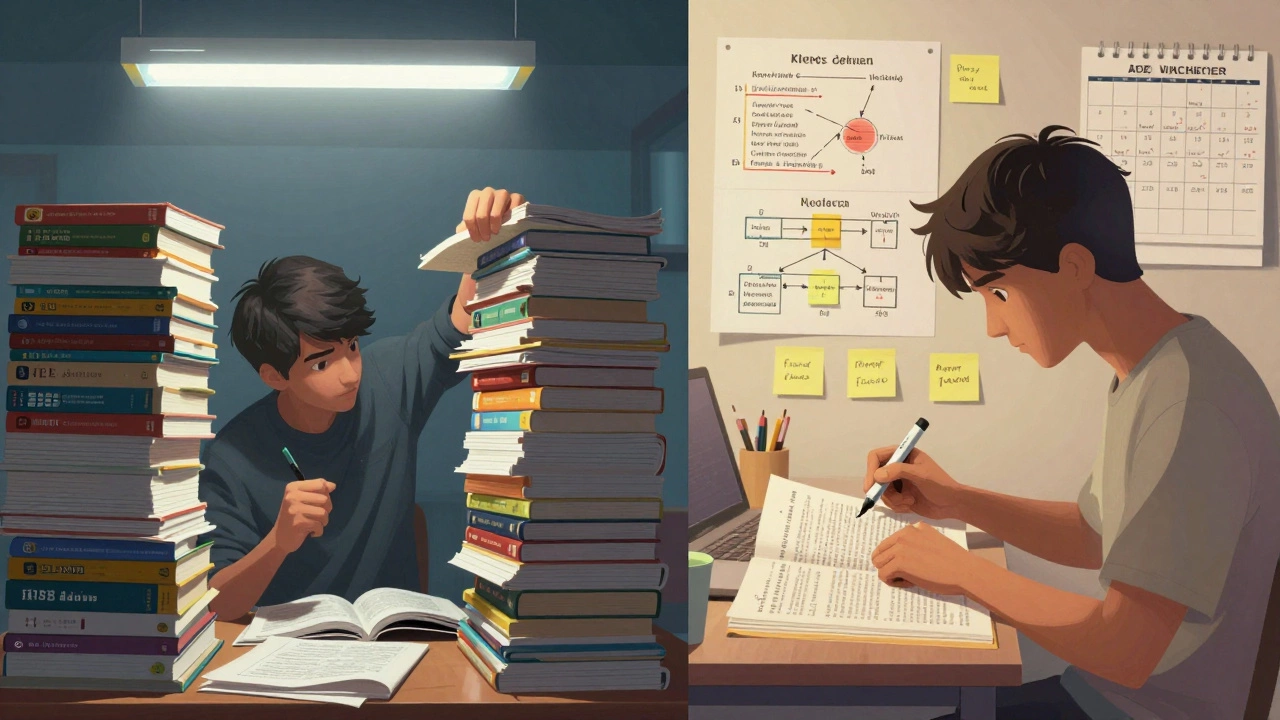
One student I know spent six months solving JEE-level physics problems. He got 62 in physics on NEET. Another student, who only did NCERT and past papers, scored 98. The difference? Focus.
How to Use Past Papers Right
Don’t just solve 10 papers. Analyze them.
Take the last five years of NEET papers. For each subject, make a list:
- Which chapters had the most questions?
- Which topics were repeated?
- Which questions were tricky? Why?
For example, in biology, the human reproduction chapter has appeared in every single NEET since 2019. Genetics? Always 4-5 questions. In chemistry, the coordination compounds chapter shows up every year. In physics, the semiconductors topic has been in 3 out of the last 5 papers.
Now, go back to NCERT. Find those exact pages. Highlight them. Make flashcards. Test yourself daily.
Study Time Allocation: The 50-30-20 Rule
Here’s a realistic daily schedule for someone studying 8 hours a day:
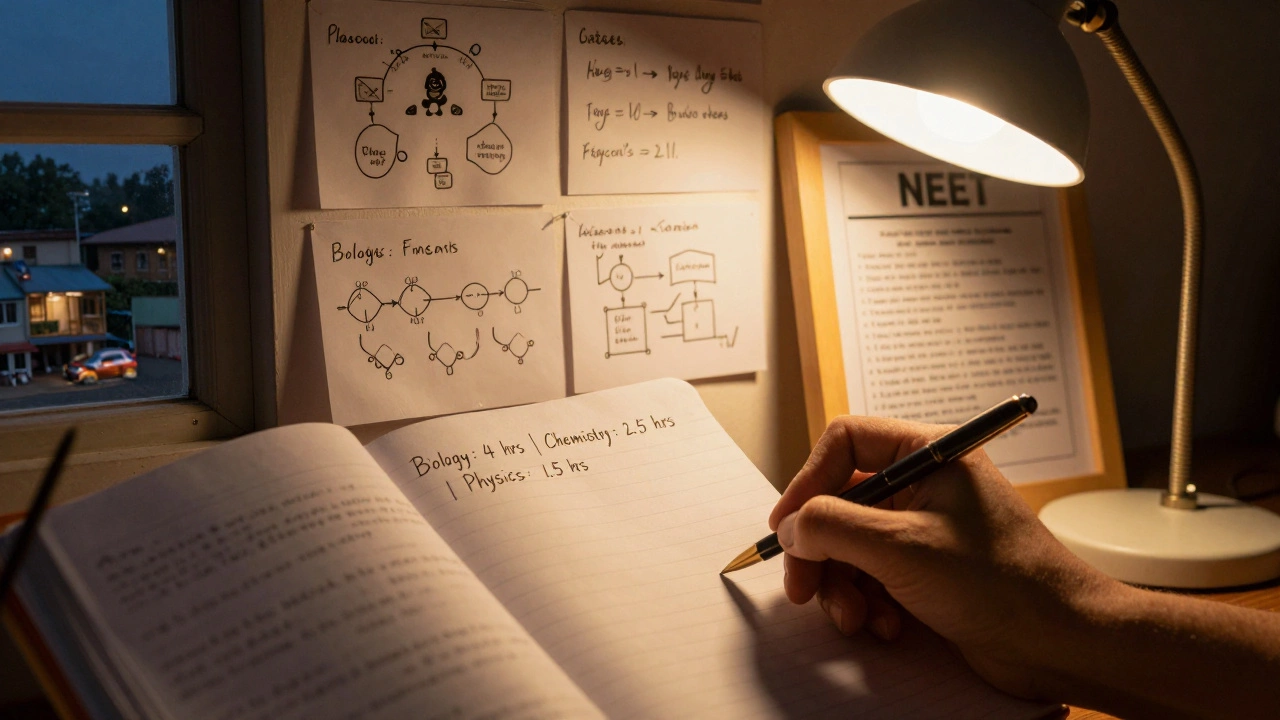
- 50% - Biology (4 hours): 2 hours reading NCERT, 1 hour diagrams, 1 hour MCQ practice.
- 30% - Chemistry (2.5 hours): 1 hour organic, 0.5 hour inorganic, 1 hour physical with formula practice.
- 20% - Physics (1.5 hours): 1 hour concept review, 0.5 hour numerical practice.
Every Sunday, take a full 3-hour mock test. No phone. No breaks. Simulate exam conditions. After each test, spend 1 hour reviewing mistakes. Don’t just note the wrong answer - write why you got it wrong. Was it a misread? A forgotten fact? A calculation error?
What Top Scorers Do Differently
They don’t study more. They study smarter.
They:
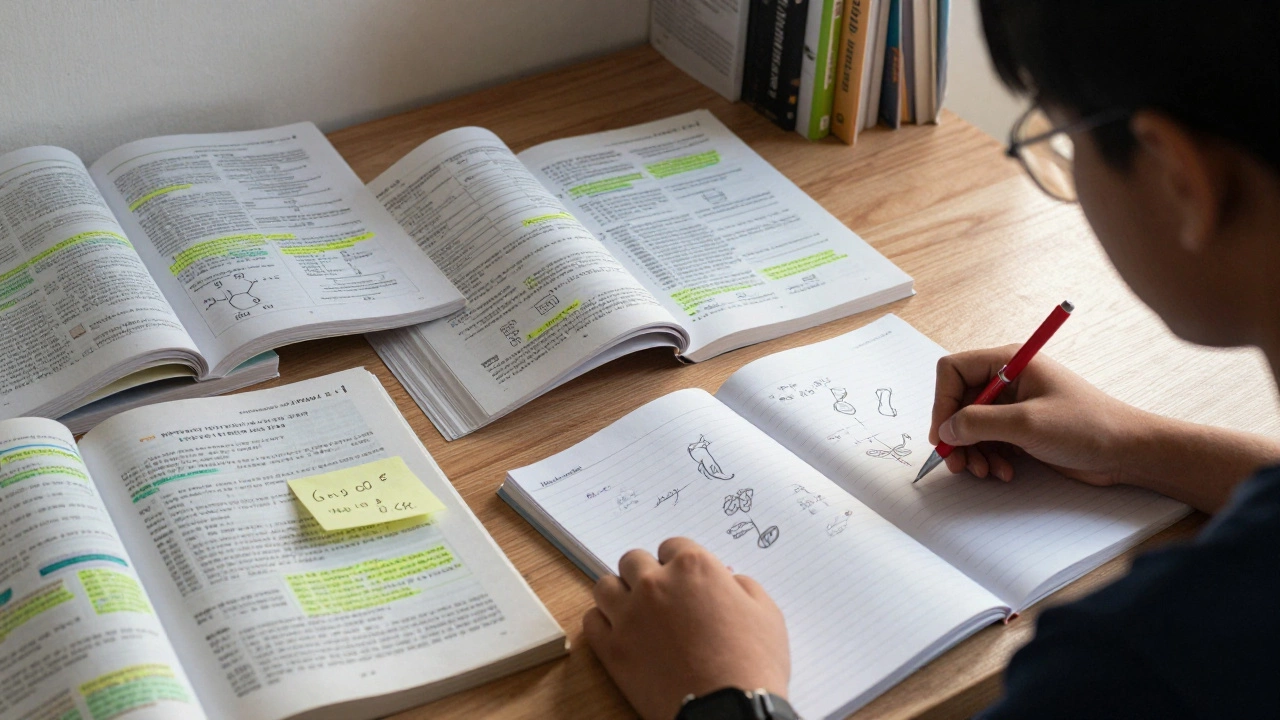
- Draw diagrams from memory - heart, nephron, brain, flower structure.
- Use sticky notes on walls for periodic table trends and chemical formulas.
- Teach a friend or explain concepts out loud - if you can’t explain it simply, you don’t know it.
- Keep a mistake journal. Not just "got wrong" - but "I confused chloroplast with mitochondria because I mixed up their functions."
One topper from Delhi told me she spent 20 minutes every morning reciting the Krebs cycle out loud. Not reading. Saying it. Out loud. That’s how she remembered it.
Final Tip: Don’t Chase Perfection
You don’t need to know everything. You need to know what’s testable.
NEET is not about who studied the most. It’s about who remembered the right things. Stick to NCERT. Master the past papers. Focus on high-yield topics. Skip the fluff. And don’t let anyone tell you that coaching notes are better than your textbook. They’re not. NCERT is the Bible. Everything else is commentary.
Is NCERT enough for NEET biology?
Yes, NCERT is enough - if you study it thoroughly. Over 80% of biology questions in NEET 2023 and 2024 came directly from Class 11 and 12 NCERT textbooks. Diagrams, tables, and even bolded definitions have appeared as questions. Don’t skip any page. Don’t assume something is "too basic." If it’s in NCERT, it’s fair game.
Should I solve JEE Advanced questions for NEET physics?
No. JEE Advanced questions are far more complex and test deep conceptual derivation. NEET physics is about applying basic formulas quickly. Focus on NCERT examples and previous NEET papers. Solving JEE problems will waste time and lower your confidence. Stick to NEET-level difficulty.
How many hours should I study daily for NEET?
There’s no magic number, but 6-8 focused hours a day works for most students. Quality matters more than quantity. Two hours of active recall and mock tests is better than 6 hours of passive reading. Use the 50-30-20 rule: 50% biology, 30% chemistry, 20% physics. Take one full mock every Sunday.
Can I crack NEET without coaching?
Absolutely. Thousands of students crack NEET every year without coaching. All you need is NCERT, past papers, and a disciplined schedule. Coaching helps with structure, but not with content. If you can manage time, track progress, and review mistakes, you don’t need a coaching center. Many top rankers from rural areas had zero coaching.
Which subject has the highest weightage in NEET?
Biology has the highest weightage - 90 out of 180 questions. That’s 50% of the paper. Scoring well in biology can make or break your rank. Most students underestimate this. If you’re aiming for a top 1000 rank, you need at least 85-90 marks in biology. Focus here first.