
Study Difficulty & Strategy Finder
Your Study Profile
Based on your responses, here's what makes studying challenging for you:
Recommended Strategies
There is no single "hardest" subject in the world of education. If there were, every student would avoid it, and universities would stop teaching it. The truth is more personal and often more frustrating: the hardest subject to study for is usually the one that clashes with your natural thinking style, lacks clear feedback loops, or requires a volume of memorization that defies logic.
For students preparing for competitive exams high-stakes standardized tests used for university admissions or professional certification, this difficulty spikes. Whether you are tackling the IIT JEE Indian Institutes of Technology Joint Entrance Examination in India, the MCAT in the US, or the UPSC Civil Services Exam, the pressure transforms manageable topics into mental mountains. Understanding why certain subjects feel impossible is the first step to conquering them.
The Cognitive Load Factor: Why Some Subjects Feel Heavier
Different subjects demand different types of brain power. Psychologists call this "cognitive load." When a subject requires you to hold multiple abstract variables in your head at once, the load becomes heavy fast. This is why mathematics and physics often top the list of "hardest" subjects for many learners.
Mathematics isn't just about numbers; it's about layered logic. You cannot skip Chapter 3 because you didn't understand Chapter 1. In contrast, history allows you to jump around. If you miss a date in 1945, it doesn't necessarily break your understanding of 1950. But if you miss the concept of derivatives, calculus becomes gibberish. This cumulative nature makes math a high-risk, high-reward subject. One gap creates a cascade of confusion.
Physics adds another layer: visualization. You aren't just solving equations; you are imagining forces acting on objects in three-dimensional space. For students who think in words rather than images, this disconnect between the text and the mental model creates immense friction.
The Memory Trap: Biology and Law
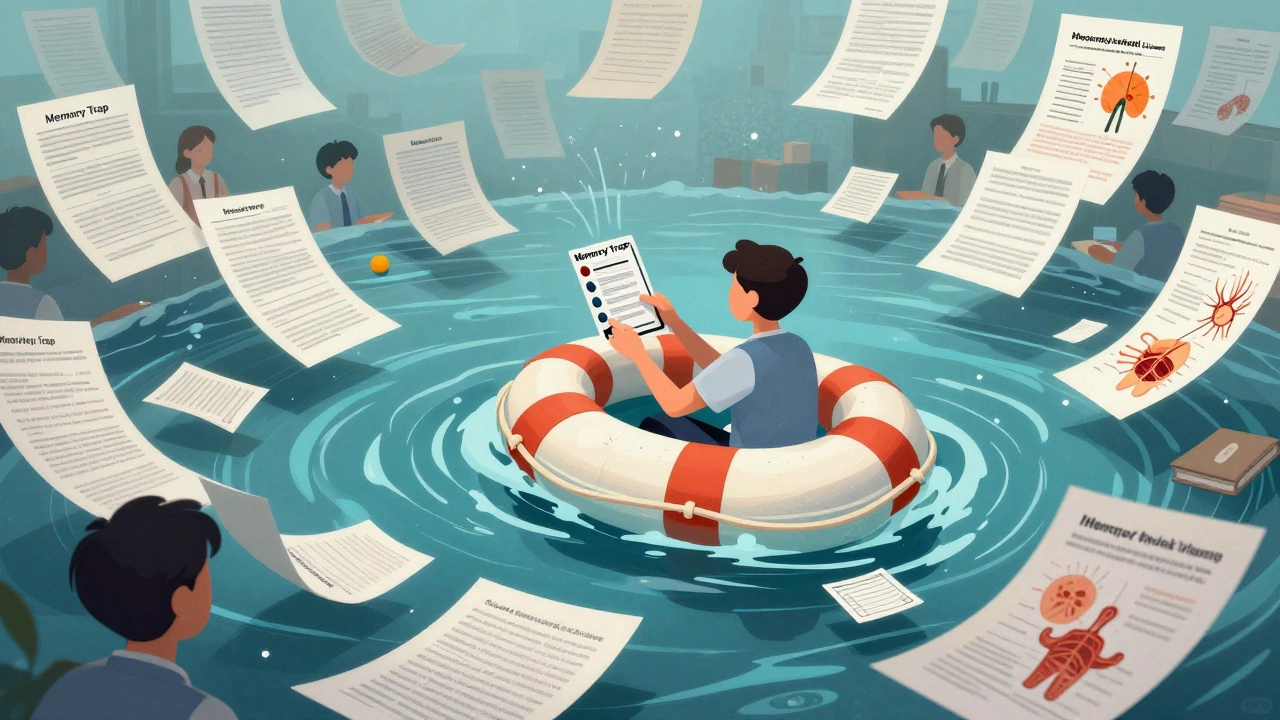
If math is hard because it's logical, biology and law are hard because they are voluminous. These subjects suffer from what we might call the "memory trap." The information density is staggering.
Consider medical entrance exams like NEET or the USMLE. A student must memorize thousands of anatomical terms, biochemical pathways, and pharmacological interactions. The challenge here isn't understanding; it's retention. How do you remember the side effects of 500 different drugs? Rote memorization works for a week, but it fails under the pressure of a three-hour exam.
Law students face a similar wall. Legal studies require not just memory, but the ability to apply rigid rules to fluid human situations. The "hardest" part of studying law is often the reading volume. Case laws are dense, archaic, and endless. Students report feeling like they are drinking from a fire hose. The difficulty lies in synthesizing vast amounts of text into concise arguments without losing nuance.
| Subject Area | Primary Challenge | Cognitive Style Required | Common Pitfall |
|---|---|---|---|
| Mathematics/Physics | Cumulative Logic | Abstract/Visual | Skipping foundational concepts |
| Biology/Medicine | Volume of Facts | Mnemonic/Associative | Rote memorization without context |
| Law/Political Science | Synthesis & Application | Analytical/Linguistic | Reading too passively |
| Languages | Immersion & Consistency | Auditory/Social | Inconsistent daily practice |
The Ambiguity Problem: Humanities and Literature
Here is a controversial take: for some students, English Literature or Philosophy is harder than Quantum Mechanics. Why? Because there is no right answer.
In science, $2+2=4$. In literature, does Hamlet act out of madness or strategy? Both can be argued. This ambiguity causes anxiety for students who crave structure. Studying for humanities exams requires a different skill set: critical analysis and persuasive writing. You aren't proving a theorem; you are building a case.
This lack of objective validation makes self-study difficult. How do you know if your essay is "good" until you get it graded? That delay in feedback slows down learning. Students often spend weeks refining an argument only to find they missed the core theme. This uncertainty makes humanities a psychological grind rather than an intellectual puzzle.
Why Competitive Exams Change the Game
When you add the label "competitive exam" to any subject, the difficulty multiplier kicks in. It’s not just about knowing the material; it’s about knowing it faster and more accurately than 100,000 other candidates.
Take the IIT JEE Advanced. The syllabus covers standard high school physics, chemistry, and math. On paper, this is manageable. In practice, the questions are designed to test limits. They combine multiple concepts in ways that never appear in textbooks. The "hardest" part of JEE preparation isn't the content itself; it's the problem-solving speed and the emotional resilience required to handle months of intense drilling.
Similarly, for the UPSC Civil Services Exam in India, the breadth is terrifying. You need to know everything from ancient Indian history to international relations, geography, and ethics. The volume of reading is equivalent to getting a master's degree in multiple fields simultaneously. The difficulty here is scope management. Where do you start? What do you ignore?
Identifying Your Personal "Hardest" Subject
To figure out which subject will trip you up, look at your past performance and your study habits. Ask yourself these questions:
- Do I procrastinate starting this subject? Procrastination is often a sign of cognitive overload. If you dread opening the textbook, your brain is signaling that the entry barrier is too high.
- Do I understand the lecture but fail the quiz? This suggests a gap in application. You recognize the information when someone else presents it, but you can't retrieve it independently. This is common in math and coding.
- Do I forget what I studied within days? This points to poor encoding strategies. This is typical in biology and history where facts are isolated rather than connected.
Your "hardest" subject is likely the one where your current study methods are misaligned with the subject's demands. Trying to memorize math formulas like vocabulary words won't work. Trying to derive historical dates logically won't work either.

Strategies to Tackle High-Difficulty Subjects
You don't have to accept that a subject is hard for you. You can change how you approach it. Here are specific tactics for the most challenging categories.
For Cumulative Subjects (Math, Physics, Coding)
Use the "First Principles" method. Break every complex problem down to its basic truths. If you are stuck on integration, go back to limits. Don't patch holes with shortcuts; rebuild the foundation. Spend 20% of your time reviewing old chapters. In cumulative subjects, the past is always present.
For Voluminous Subjects (Biology, Law, History)
Active recall is non-negotiable. Passive reading is the enemy. After reading a page, close the book and write down everything you remember. Use spaced repetition software (like Anki) to manage the sheer volume of facts. Turn dry data into stories. Humans remember narratives better than lists. Imagine the Krebs cycle as a factory assembly line, not just a diagram.
For Ambiguous Subjects (Literature, Ethics, Essay Writing)
Create frameworks. Since there is no single right answer, build a template for analysis. For essays, use structures like PEEL (Point, Evidence, Explanation, Link). Practice writing under timed conditions. Get feedback early and often. Join a study group where you can debate interpretations. Arguing your point clarifies your thinking.
The Role of Mental Health in Perceived Difficulty
We cannot talk about difficult subjects without talking about burnout. Often, a subject feels impossibly hard not because of its content, but because of the student's state of mind. Anxiety narrows focus. When you are stressed, your working memory shrinks. Complex problems become unsolvable because your brain is too busy fighting panic.
Students preparing for competitive exams often fall into the comparison trap. Seeing peers breeze through organic chemistry while you struggle makes you feel inadequate. Remember: everyone has a different "hard" subject. Your friend might ace math but cry over poetry. Normalize the struggle. Take breaks. Sleep is when memory consolidation happens. Pulling all-nighters actually makes the next day's studying harder, not easier.
Conclusion: It’s About Fit, Not Intelligence
The hardest subject to study for is the one that doesn't fit your current toolkit. By identifying whether your challenge is logical, volumetric, or ambiguous, you can swap out ineffective study habits for targeted strategies. Competitiveness adds pressure, but it also provides structure. Use the exam syllabus as a map, not a mountain. Break it down, attack the weak spots, and trust the process. Mastery comes not from innate genius, but from persistent, smart effort.
Is Mathematics really the hardest subject for everyone?
No. While mathematics is challenging due to its cumulative nature, it is highly logical. For visual or linguistic learners, subjects like Biology or Literature may feel significantly harder because they rely on memorization or subjective interpretation rather than clear-cut rules.
How can I make a difficult subject easier to study?
Align your study method with the subject type. For logical subjects, focus on first principles and practice problems. For factual subjects, use active recall and spaced repetition. For ambiguous subjects, create analytical frameworks and seek feedback on your arguments.
Why do competitive exams make subjects feel harder?
Competitive exams introduce time pressure and high stakes. They often test application and synthesis rather than simple recall. The fear of failure increases cognitive load, making it harder to access knowledge you already possess.
What is the best way to study for voluminous subjects like Biology or Law?
Avoid passive reading. Use techniques like active recall, where you test yourself frequently. Create mnemonics and associations to link new information to things you already know. Spaced repetition apps can help manage the large volume of facts without overwhelming your short-term memory.
Can changing my mindset help with difficult subjects?
Absolutely. Viewing difficulty as a lack of intelligence leads to paralysis. Viewing it as a mismatch in study strategy leads to action. Adopting a growth mindset helps you persist through frustration, which is essential for mastering complex topics.