Coding Language Recommendation Finder
What do you want to build?
Select the option that best matches your primary interest.
Select a goal on the left to see your recommended first language.
You’re staring at a list of programming languages. Python, Java, C++, JavaScript. The options are endless, and the fear of picking the "wrong" one is real. Here’s the truth: there is no single wrong choice, but there is definitely a best first step depending on what you actually want to build. If you pick something too abstract, like Assembly, you’ll quit in a week because it feels like reading hieroglyphics. If you pick something too niche, you might find zero job openings near you. The goal isn’t just to learn syntax; it’s to keep your momentum high enough to finish your first project.
Start With Your Goal, Not The Hype
Most people ask, "What is the most popular language?" That’s the wrong question. Popularity doesn’t equal ease of learning or relevance to your specific career path. Ask yourself this instead: What do I want to create? Are you building websites that people click on? You need JavaScript, which is the standard scripting language for web browsers. Want to analyze data or build AI models? Python is a high-level, general-purpose programming language known for its readability. Building mobile apps for iPhone users? You’re looking at Swift, Apple’s proprietary language for iOS development.
Choosing based on your end goal saves months of frustration. If you hate math and logic puzzles, don’t start with C++. If you love visual feedback, don’t start with backend-only languages. Match the tool to the job you want to do.
The Case For Python As The Universal Starter
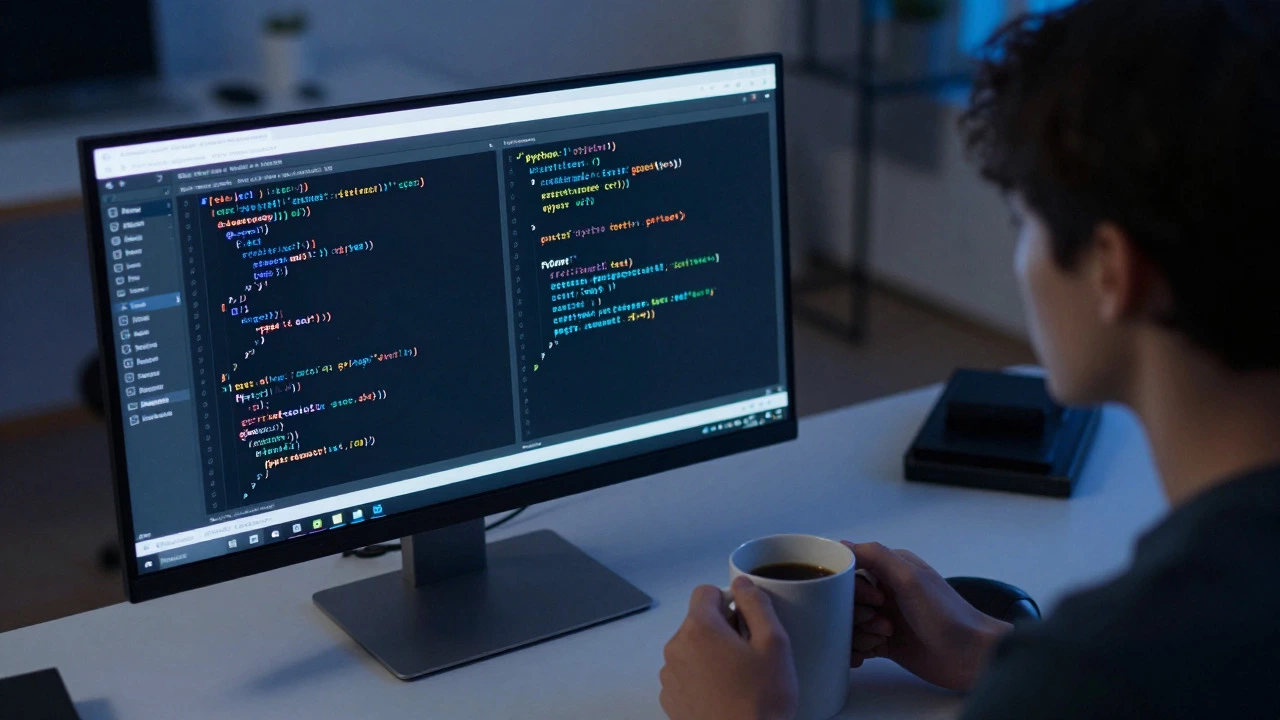
If you have absolutely no idea what you want to build yet, start with Python. It reads almost like English. Compare these two lines of code:
- C++:
std::cout << "Hello World" << std::endl; - Python:
print("Hello World")
See the difference? Python removes the clutter. You spend less time fighting with semicolons and brackets and more time solving problems. This makes it ideal for beginners who get discouraged by technical errors. Beyond simplicity, Python dominates in fields like data science, machine learning, and automation. Libraries like Pandas and NumPy let you manipulate massive datasets without writing complex algorithms from scratch. If you live in Sydney or any tech hub, Python skills open doors in finance, healthcare, and startups alike.
Why JavaScript Is Essential For Web Developers
If you want to see things happen on screen immediately, JavaScript is your best friend. It runs directly in your browser. No installation, no compilation steps. Just write code, refresh the page, and watch your button change color. This instant feedback loop keeps motivation high. While HTML structures the page and CSS styles it, JavaScript makes it interactive. Think about dropdown menus, image sliders, or real-time chat features. None of those work without JS.
Some beginners worry they need to learn three languages (HTML, CSS, JS) before doing anything useful. That’s not true. You can build functional prototypes with just JavaScript and basic HTML. Plus, frameworks like React and Vue.js make JavaScript incredibly powerful for modern web applications. If your dream is to freelance or launch a startup MVP quickly, JavaScript offers the fastest route to visible results.
When To Choose Java Or C# Instead
Not everyone wants to be a web developer or a data scientist. Some careers demand robust, object-oriented systems used in large enterprises. Enter Java and C#. Both are statically typed, meaning you must define variable types explicitly. This sounds annoying at first, but it catches errors early. In a team of fifty developers working on banking software, strict typing prevents catastrophic bugs.
Java remains the backbone of Android development (though Kotlin is rising) and enterprise server-side applications. It’s verbose but stable. C#, developed by Microsoft, powers game development through Unity and Windows desktop applications. If you want to make video games, C# is non-negotiable. These languages teach you fundamental computer science concepts better than Python because they force you to think about memory management and structure. They are harder to learn initially but pay off in long-term employability in corporate sectors.
| Language | Best For | Learning Curve | Job Market Demand | Key Ecosystem |
|---|---|---|---|---|
| Python | Data Science, AI, Automation | Low (Very Easy) | High & Growing | Pandas, TensorFlow, Django |
| JavaScript | Web Development, Frontend | Medium (Easy Start) | Extremely High | React, Node.js, Angular |
| Java | Android, Enterprise Backend | Medium-High | Stable & Strong | Spring Boot, Android SDK |
| C# | Game Dev, Windows Apps | Medium | Strong (Microsoft Stack) | Unity, .NET Core |
| SQL | Data Analysis, Database Mgmt | Low (Specialized) | Universal Requirement | PostgreSQL, MySQL, BigQuery |
Don't Ignore SQL And Git
Here is a secret most tutorials skip: knowing one programming language isn’t enough. You need supporting tools. SQL is a domain-specific language used in programming for managing relational databases. Almost every app stores data. Whether you use Python or JavaScript, you will eventually query a database. Learning basic SELECT, INSERT, and JOIN commands takes a weekend but makes you infinitely more hireable. It pairs perfectly with any main language.
Similarly, Git is a distributed version control system for tracking changes in source code. You cannot collaborate effectively without it. Treat Git as a mandatory companion skill. Don’t wait until you’re an expert programmer to learn it. Start using GitHub from day one. Commit your code daily. This builds good habits and creates a portfolio employers actually look at during interviews.

Avoiding Common Beginner Traps
One major mistake is "tutorial hell." You watch ten hours of videos but never write code yourself. Passive consumption feels productive, but it isn’t. You only learn when you break something and fix it. Another trap is switching languages too soon. After two weeks of Python, you might hear that Rust is faster, so you jump ship. Then you try Go. Now you know fragments of three languages and mastered none. Stick with your first choice for at least three months. Build three small projects. Only then consider expanding your toolkit.
Also, ignore the debate warriors online. Someone will always tell you that your chosen language is "dead" or "for amateurs." In reality, legacy systems run on COBOL and still process trillions of dollars. Modern stacks evolve, but fundamentals transfer. Logic learned in Python applies to C++. Concepts in JavaScript apply to TypeScript. Focus on problem-solving skills, not just syntax memorization.
How To Structure Your First Month
Ready to start? Here’s a realistic plan for your first thirty days. Week one: Install your editor (VS Code is free and great). Learn variables, loops, and conditionals. Write simple scripts like a calculator or a number guessing game. Week two: Dive into functions and data structures like lists and dictionaries. Try to solve easy coding challenges on sites like LeetCode or HackerRank. Week three: Pick a mini-project. If Python, build a weather scraper. If JavaScript, make a to-do list app. Week four: Polish your project, push it to GitHub, and read documentation. Documentation is where pros live. Get comfortable reading official docs rather than relying solely on YouTube.
This structured approach prevents overwhelm. You aren’t trying to learn everything. You are building muscle memory. Consistency beats intensity. Thirty minutes every day outperforms five hours once a week.
Is Python really easier than JavaScript for beginners?
Generally, yes. Python has cleaner syntax and fewer punctuation requirements, making it easier to read and write for absolute beginners. JavaScript requires understanding browser environments and asynchronous behavior earlier, which can confuse newcomers. However, if you are visually motivated, seeing immediate results in a browser might make JavaScript feel more rewarding despite its complexity.
Can I learn two coding languages at the same time?
It is usually not recommended for complete beginners. Learning two languages simultaneously often leads to confusion between syntax rules and concepts. It is better to achieve proficiency in one language first. Once you understand core programming concepts like loops, functions, and objects, picking up a second language becomes significantly faster because you are focusing on new syntax rather than new logic.
Does it matter if I choose a paid course or free resources?
The quality of content matters more than the price tag. Free resources like freeCodeCamp, The Odin Project, and official documentation are excellent. Paid courses offer structure, community support, and accountability, which helps some learners stay consistent. Choose whichever format keeps you engaged and completing lessons. Many successful developers are entirely self-taught using free materials.
Should I learn HTML/CSS before JavaScript?
Yes, basic knowledge of HTML and CSS is essential before diving deep into JavaScript. HTML provides the structure of a webpage, and CSS handles the styling. JavaScript interacts with these elements. Without understanding how the DOM (Document Object Model) works via HTML tags, JavaScript lacks context. Spend a week on HTML/CSS basics, then integrate them with your JS learning.
Which language pays the most for juniors?
Salary varies by location and industry, but generally, specialized skills command higher pay. Data-focused roles requiring Python or R often pay well due to the analytical value. Full-stack JavaScript developers are in high demand globally. However, junior salaries depend more on your ability to build deployable projects and communicate clearly than on the specific language itself. Mastering fundamentals outweighs chasing the highest-paying keyword.