
IIT Branch Difficulty Matcher
Answer these questions honestly to see which branches align with your natural abilities and where you might face the most friction.
Your Personalized Branch Analysis
You’ve cracked JEE Advanced and secured a seat at an Indian Institute of Technology. You’re celebrating with your family, posting on Instagram, maybe even booking tickets to your dream city. But then, a quiet anxiety creeps in. You hear whispers from seniors: "Computer Science is easy, but Electrical Engineering will break you." Or maybe, "Don’t take Mechanical if you hate math-heavy physics." The question isn't just about getting into an IIT anymore; it’s about surviving the four years that follow. Which branch is actually the hardest?
Here’s the uncomfortable truth: there is no single "toughest" branch. If you ask a first-year student, they’ll say Physics. Ask a final-year student who just survived their thesis, and they might say Chemical Engineering. The difficulty depends entirely on what your brain finds painful. For some, it’s abstract mathematics. For others, it’s memorizing complex chemical reactions or debugging code at 3 AM. This guide breaks down the real academic load of major IIT branches, helping you choose not just based on placements, but on what you can actually handle without burning out.
The Myth of the "Easy" Branch
Let’s kill this myth right now. There is no such thing as an easy branch at an IIT. The IIT curriculum is designed to be rigorous across the board. Whether you are in Civil Engineering or Computer Science, you will face core subjects like Mathematics, Physics, and Humanities that apply to everyone. The difference lies in the specialization depth.
Many students believe that because Computer Science and Engineering (CSE) has the highest cut-offs, it must be the easiest to study. That’s backward logic. High cut-offs mean high competition for entry, not low effort during the degree. In fact, CSE students often face intense pressure to maintain a high CGPA for top-tier tech jobs, which adds a layer of psychological stress that other branches might not experience to the same degree.
Difficulty is subjective. It comes down to three factors:
- Cognitive Load: How much new information do you need to absorb per week?
- Practical Workload: How many hours do you spend in labs or coding?
- Evaluation Style: Are exams multiple-choice, open-ended problem-solving, or project-based?
Branches Often Cited as Most Rigorous
While every student’s experience varies, certain branches consistently appear in conversations about high academic stress. Let’s look at why.
Electrical Engineering (EE)
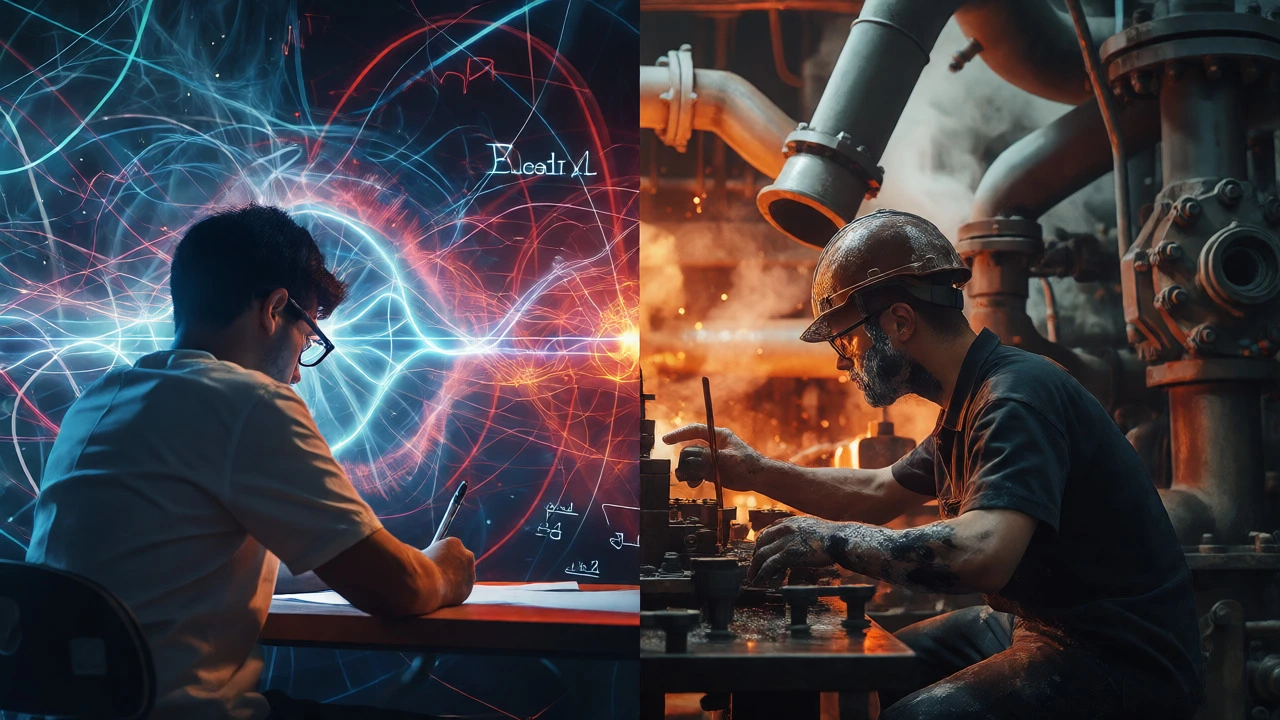
Electrical Engineering is frequently cited as one of the most conceptually difficult branches. Why? Because it relies heavily on advanced mathematics and abstract physics concepts that aren’t always intuitive. You’re dealing with electromagnetic fields, signal processing, and control systems-topics that require strong visualization skills and heavy calculus.
Students in EE often struggle with subjects like Electromagnetic Theory and Power Systems. Unlike mechanical parts you can see moving, electrons and waves are invisible. If you didn’t love physics in school, EE can feel like climbing a wall. The lab work is also demanding, requiring precise circuit building and troubleshooting where a single loose wire can ruin hours of work.
Mechanical Engineering
Often called the "mother of all engineering," Mechanical Engineering is broad and physically demanding. You cover thermodynamics, fluid mechanics, materials science, and manufacturing processes. The sheer volume of content is massive. You aren’t just learning theory; you’re often required to design, build, and test physical prototypes.
The challenge here is breadth. You need to understand how heat moves, how fluids flow, and how metals behave under stress-all while managing CAD software projects and workshop duties. For students who prefer deep specialization over broad application, the constant switching between topics can be exhausting.
Chemical Engineering
If you think chemistry was hard in high school, wait until you hit Chemical Engineering. This branch combines chemistry, physics, biology, and mathematics in a way that few other disciplines do. Core subjects like Transport Phenomena (which covers momentum, heat, and mass transfer) are notoriously difficult because they involve complex differential equations applied to real-world industrial processes.
The workload includes extensive laboratory sessions where safety protocols are strict, and experiments can fail due to minor temperature or pressure variations. Plus, the theoretical models often assume ideal conditions that don’t exist in reality, forcing you to constantly adjust your understanding.
| Branch | Primary Difficulty Factor | Math Intensity | Lab/Practical Load | Common Pain Points |
|---|---|---|---|---|
| Electrical Engineering | Abstract Concepts | Very High | High | Electromagnetics, Signal Processing |
| Mechanical Engineering | Breadth of Topics | High | Very High | Thermodynamics, Workshop Projects |
| Chemical Engineering | Interdisciplinary Mix | High | High | Transport Phenomena, Reaction Kinetics |
| Computer Science | Rapid Evolution & Pressure | Moderate-High | Moderate | Algorithms, System Design, Interview Prep |
| Civil Engineering | Physical & Field Work | Moderate | High | Structural Analysis, Site Visits |
Is Computer Science Actually Easy?
This is the biggest misconception among aspirants. Yes, Computer Science doesn’t have the same kind of mathematical abstraction as Electrical Engineering. You won’t be solving Maxwell’s equations. But don’t mistake that for ease.
The difficulty in CSE comes from the pace of change and the expectation of self-learning. What you learn in class might be outdated by the time you graduate. You are expected to know frameworks, languages, and tools that aren’t in the syllabus. Furthermore, the placement culture in India places immense weight on coding interviews. While other branches might focus on GATE preparation or core industry roles, CSE students spend their third and fourth years grinding LeetCode problems and system design patterns. The mental fatigue from constant competitive programming practice is real.
If you hate coding or find logical puzzles frustrating, CSE will feel incredibly tough. But if you enjoy building things and solving logical errors, you might find it more manageable than the abstract theories in EE or CE.
How to Decide What’s Tough for YOU
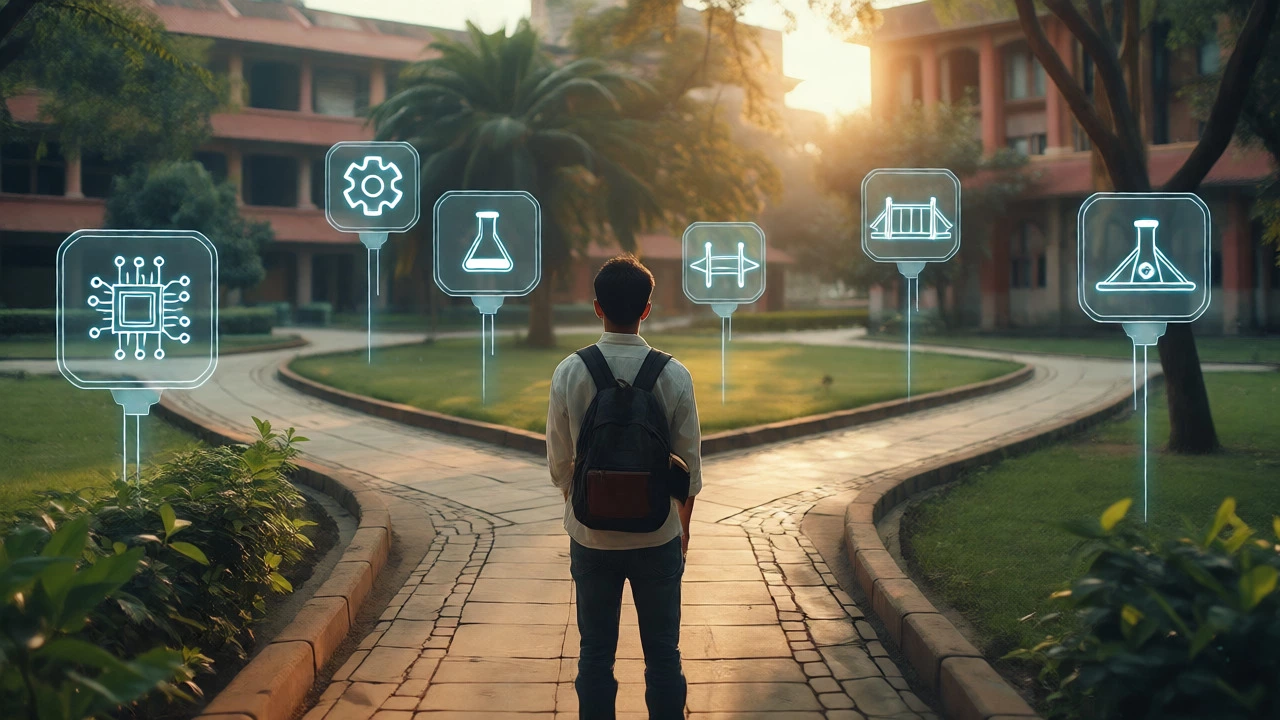
Instead of asking "What is the hardest branch?", ask yourself these questions. Your answers will reveal your personal tolerance for difficulty.
1. Do you prefer concrete or abstract problems?
If you like seeing results-like a machine moving or a bridge standing-Mechanical or Civil might suit you better. If you can visualize invisible forces like electric fields or data structures, Electrical or CS might be easier for you. Abstract thinking is a skill, not a talent. If you lack it, those branches will feel twice as hard.
2. How do you handle failure in practicals?
In Chemical and Mechanical engineering, experiments fail. Code compiles or it doesn’t. Circuits work or they don’t. If you get frustrated when things don’t work despite doing everything right, branches with heavy lab components (CE, ME, EE) will cause significant stress.
3. Are you comfortable with continuous upskilling?
Tech fields evolve fast. If you want a stable curriculum where Newton’s laws haven’t changed in 300 years, stick to traditional engineering branches. If you’re okay with learning new technologies every semester, CSE or IT might be less stressful academically but more stressful career-wise.
The Role of Campus Culture and Faculty
We can’t ignore the environment. An old IIT like Bombay or Delhi has a different academic culture than a newer IIT. At older institutes, the faculty research output is higher, which means the coursework often touches on cutting-edge, unsolved problems. This makes the material harder but also more rewarding.
Newer IITs sometimes have a more structured, textbook-focused approach. While this might make passing exams slightly easier, it can leave students feeling underprepared for advanced research or niche industries. Also, consider the peer group. If you are surrounded by highly competitive peers who study 12 hours a day, you will feel pressured to keep up, regardless of the branch. This social pressure often feels tougher than the actual syllabus.
Strategies to Survive the "Toughest" Branch
No matter which branch you pick, survival requires strategy. Here is what senior students swear by:
- Prioritize Core Subjects Early: Don’t procrastinate on Math or Physics. These form the foundation for specialized subjects. If you fall behind in Calculus, Thermodynamics becomes impossible.
- Form Study Groups: Teaching a concept to someone else is the best way to learn it. Explaining why a circuit failed helps you understand it better than reading the book alone.
- Utilize Office Hours: Professors at IITs are generally accessible. Go to their office hours with specific questions. It shows interest and often leads to better guidance on projects.
- Manage Expectations: You don’t need a 9.0 CGPA to succeed. Many successful engineers graduated with average scores but had strong portfolios or internships. Focus on understanding, not just grading.
Final Verdict: Which One Should You Fear Least?
If you love math and abstract reasoning, Electrical Engineering might feel natural, while Mechanical feels chaotic. If you love hands-on building, Mechanical is fun, while Electrical feels dry. If you love logic and speed, CS is exhilarating, while Chemical feels slow and messy.
The "toughest" branch is simply the one that clashes with your natural strengths. Choose based on what you can tolerate struggling with for four years. Passion makes the pain bearable. Interest makes the difficult concepts click. Don’t pick a branch just because it’s popular or because it’s supposedly "easy." Pick the one where the struggle feels worth it.
Is Computer Science really the easiest branch at IIT?
No, it is not necessarily the easiest. While the theoretical math might be less abstract than in Electrical Engineering, the workload involves constant self-study of evolving technologies and intense preparation for coding interviews. The pressure to perform well in placements can make it mentally taxing compared to branches with more traditional job paths.
Which IIT branch has the highest dropout rate?
Dropout rates vary by campus, but branches with heavy mathematical and conceptual loads like Electrical and Chemical Engineering often see students struggling initially. However, most students complete their degrees. Switching branches is possible after the first year at many IITs, which allows students to move away from subjects they find unmanageable.
Does the difficulty of the branch affect placement opportunities?
Not directly. Companies hire based on skills and interview performance, not just branch difficulty. However, a lower CGPA resulting from a very tough branch might impact eligibility criteria for some firms. Conversely, mastering a tough branch demonstrates resilience and analytical ability, which can be attractive to employers in R&D roles.
Can I switch from a tough branch like EE to CS later?
Yes, most IITs allow branch changes after the first year based on CGPA. Students from tough branches like EE often switch to CS or Data Science if they realize their interests lie elsewhere. However, you will need to catch up on CS-specific prerequisites independently.
Is Mechanical Engineering harder than Civil Engineering?
Generally, Mechanical Engineering is considered broader and more mathematically intensive due to subjects like Dynamics and Control Systems. Civil Engineering focuses more on structural analysis and geotechnical aspects, which can be physically demanding due to fieldwork but may involve slightly less abstract mathematical modeling than Mechanical.