IIT Admissions Probability Estimator
Input Your Details
Based on recent data trends for General Category.
Estimated Admission Results
Enter your rank above to see which IITs you might qualify for.
Getting into an Indian Institute of Technology (IIT) is a dream for millions of students in India. But not all IITs are created equal when it comes to difficulty. Some campuses have acceptance rates lower than Harvard or Stanford. If you are aiming for the absolute peak of engineering education in India, you need to know exactly which gate is the hardest to open.
The short answer? IIT Bombay is widely considered the hardest IIT to get into overall. However, the reality is more nuanced. Depending on your branch of interest-Computer Science vs. Civil Engineering-the "hardest" institute shifts. For Computer Science and Engineering (CSE), IIT Delhi often demands a higher rank than Bombay. This guide breaks down the data, the rankings, and the strategy you need to crack these elite institutions in 2026.
The Big Three: Why They Are Different
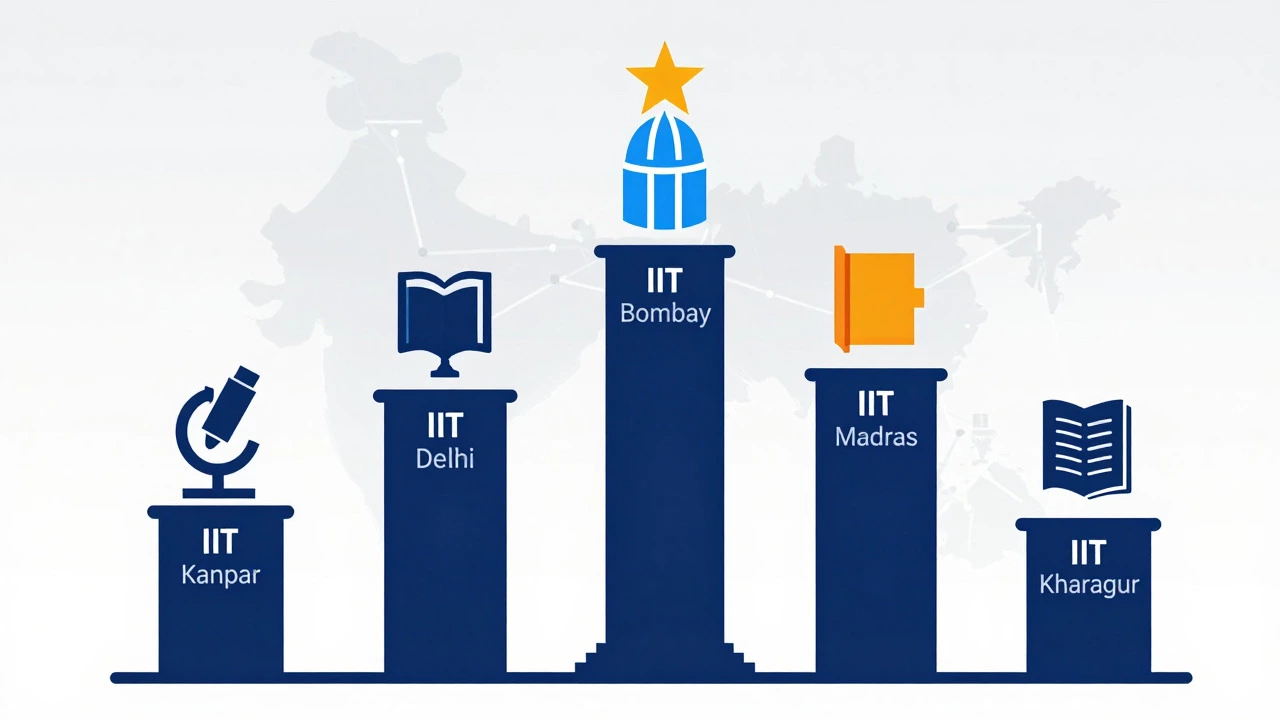
When people talk about the "hardest" IITs, they usually refer to the old IITs established before 1963. These are known as the "Big Five": IIT Bombay, IIT Delhi, IIT Kanpur, IIT Madras, and IIT Kharagpur. Among these, three stand out for their extreme selectivity: Bombay, Delhi, and Kanpur.
IIT Bombay holds the crown for general prestige. Located in Mumbai, the financial capital of India, it has unparalleled industry connections. Its alumni network is powerful in tech, finance, and entrepreneurship. Because of this brand value, every top-ranker aims for Bombay first. The competition isn't just about intelligence; it's about beating hundreds of thousands of other brilliant students who want that specific campus name on their resume.
IIT Delhi is the rival. It is located in the heart of New Delhi, close to government hubs and startups. For Computer Science, IIT Delhi is often harder to get into than Bombay. Why? Because Delhi offers CSE with a slightly higher cutoff in many years due to its location and perceived placement packages in core tech firms. If your goal is pure coding and software engineering, Delhi might be the ultimate boss level.
IIT Kanpur is different. It is less flashy than Bombay or Delhi but is academically rigorous. Kanpur is famous for research and academia. Many students who aim for PhDs abroad prefer Kanpur. It doesn't always have the lowest cutoff ranks for CSE, but for branches like Mechanical or Electrical, getting into Kanpur can be tougher than getting into newer IITs. It attracts students who prioritize academic depth over city life.
Understanding Cutoff Ranks: The Real Metric
To understand which IIT is hardest, you must look at the JEE Advanced cutoff ranks. The Joint Entrance Examination (Advanced) is the gateway. Only the top ~25,000 students from JEE Main qualify for JEE Advanced. From those, only about 17,000 seats are available across all IITs, NITs, and IIITs combined.
Let’s look at the approximate closing ranks for Computer Science and Engineering (CSE) for General Category students in recent years. These numbers fluctuate slightly each year based on paper difficulty and seat matrix changes, but the trend remains consistent.
| Institute | Typical Closing Rank Range | Difficulty Level |
|---|---|---|
| IIT Delhi | 1 - 150 | Extreme |
| IIT Bombay | 1 - 200 | Extreme |
| IIT Madras | 150 - 400 | Very High |
| IIT Kanpur | 200 - 500 | Very High |
| IIT Kharagpur | 400 - 800 | High |
Notice something interesting? For CSE, IIT Delhi is often the hardest. You need to be in the top 150 nationally. That means you cannot afford a single silly mistake in JEE Advanced. For IIT Bombay, the range is slightly wider, up to 200. But remember, Bombay has fewer CSE seats compared to Delhi. So, while the rank range looks similar, the margin for error is razor-thin.
If you are looking at other branches, the dynamics change. For example, getting into Civil Engineering at IIT Bombay might require a rank of 2,000-3,000. Getting into Chemical Engineering at IIT Kanpur might require a rank of 1,000-1,500. So, "hardest" depends entirely on what you want to study.
The Role of Quotas: Why Your Background Matters
You cannot talk about IIT admissions without mentioning quotas. The reservation policy in India significantly impacts the "effective" difficulty for different groups. The seats are divided into:
- General (GEN): No reservation. Most competitive.
- EWS (Economically Weaker Sections): 10% reservation.
- OBC-NCL (Other Backward Classes - Non-Creamy Layer): 27% reservation.
- SC (Scheduled Castes): 15% reservation.
- ST (Scheduled Tribes): 7.5% reservation.
- PwD (Persons with Disabilities): 5% horizontal reservation.
For a General category student, the competition is brutal. You are fighting against the entire unreserved pool. For OBC-NCL students, the cutoff ranks are relaxed. An OBC student might get into IIT Bombay CSE with a rank of 500-600, whereas a General student needs a rank under 200. This doesn't mean the exam is easier for OBC students; it means the quota system allocates specific seats to ensure diversity.
If you are from a reserved category, "hardest" still applies to IIT Bombay and Delhi, but the numerical barrier is lower. You still need to be in the top percentile of your category. Don't underestimate the competition within quotas. Top coaching centers now have specialized batches for OBC and SC students, raising the baseline performance.

Why IIT Bombay Is the Overall Champion of Difficulty
Despite Delhi being harder for CSE, IIT Bombay retains the title of the hardest IIT overall. Here is why:
- Brand Value: Bombay is the most recognized IIT globally. Recruiters, especially in Silicon Valley and European tech hubs, instantly recognize the name.
- Entrepreneurship Hub: Bombay has one of the best incubation centers in Asia. Students here launch startups at a higher rate than any other IIT. This attracts ambitious, high-risk-taking students who are also academically elite.
- Campus Culture: The campus in Powai, Mumbai, is iconic. It has a unique culture that blends academic rigor with vibrant student life. Everyone wants to be part of this legacy.
- Placement Packages: While Delhi and Madras also offer high packages, Bombay consistently reports some of the highest average and median salaries across all branches, not just CSE.
Because of this holistic appeal, students who are good at Math, Physics, and Chemistry but aren't sure about their branch often pick Bombay as their first choice. This drives up the demand for all branches, pushing the cutoff ranks higher even for non-core subjects.
IIT Madras: The Rising Contender
In the last five years, IIT Madras has surged in popularity. Located in Chennai, it benefits from the growing IT hub in Tamil Nadu. Companies like Google, Microsoft, and Amazon have strong offices in Bangalore and Chennai, making IIT Madras a prime target for recruiters.
Madras is now consistently in the top 3 for CSE cutoffs. In some years, it has surpassed IIT Kanpur and even approached IIT Bombay in terms of closing ranks for certain branches. The infrastructure at Madras is modern, and the focus on interdisciplinary studies (like AI and Data Science) appeals to the new generation of engineers. If you are preparing in 2026, do not ignore Madras. It is no longer a "second choice" after Bombay and Delhi; it is a primary target for top rankers.
Strategy: How to Crack the Hardest IITs
Knowing which IIT is hardest is useless if you don't have a plan to beat it. Here is how top rankers approach JEE Advanced preparation:
1. Master the Basics, Not Just Tricks
JEE Advanced is designed to test conceptual clarity. Shortcuts work in JEE Main, but they fail in Advanced. You need to understand *why* a formula works, not just *how* to use it. Spend 60% of your time on NCERT textbooks and standard reference books like H.C. Verma for Physics and Irodov for problem-solving.
2. Analyze Previous Year Questions (PYQs)
Solve the last 10 years of JEE Advanced papers. Not just once, but multiple times. Notice patterns. Does IIT Bombay love asking questions about Rotational Motion? Does IIT Delhi favor Electrostatics? PYQs reveal the mindset of the question setters. Treat them as gold.
3. Mock Tests Are Non-Negotiable
You need to simulate the exam environment. Take full-length mock tests every weekend. Analyze your mistakes ruthlessly. Did you lose marks because of calculation errors? Conceptual gaps? Time management? Fix these issues immediately. Top rankers often take 50+ mocks before the actual exam.
4. Focus on Weak Areas Early
Don't wait until the last month to fix weak topics. If you struggle with Organic Chemistry, start solving problems in it today. Weak areas drag down your total score. In JEE Advanced, a balanced score across Physics, Chemistry, and Math is crucial. Being exceptional in one subject and average in others rarely gets you into the top 100.
5. Mental Resilience
The pressure to get into IIT Bombay or Delhi is immense. Burnout is real. Maintain a healthy routine. Sleep 7-8 hours. Exercise. Talk to friends. Mental strength is as important as intellectual strength. Many smart students crack JEE Advanced not because they studied 18 hours a day, but because they stayed calm under pressure.
Is It Worth the Stress?
Getting into the hardest IITs is challenging. But is it worth it? Absolutely. The network you build, the opportunities you get, and the confidence you gain stay with you for life. Even if you don't get into IIT Bombay, getting into IIT Madras or IIT Kanpur is a massive achievement. There are 23 IITs now, and all of them offer excellent education.
Remember, the "hardest" IIT is subjective. For some, it's Bombay. For others, it's Delhi. For a researcher, it's Kanpur. Define your own goals. Prepare with intensity. And when you sit for JEE Advanced, give it your best shot. The rest will follow.
What is the cutoff rank for IIT Bombay CSE in 2025?
For the General category, the closing rank for Computer Science and Engineering at IIT Bombay was approximately between 150 and 200 in 2025. This varies slightly each year based on the number of seats and paper difficulty.
Is IIT Delhi harder than IIT Bombay?
For Computer Science and Engineering, IIT Delhi is often harder to get into than IIT Bombay, requiring a slightly better rank (top 150 vs top 200). However, for other branches, IIT Bombay may have stricter cutoffs due to its overall brand preference.
Which IIT is best for research?
IIT Kanpur and IIT Bombay are both highly regarded for research. IIT Kanpur is particularly known for its strong academic foundation and faculty focused on fundamental sciences and engineering research. Many students from Kanpur pursue PhDs at top global universities.
How many seats are there in IITs for JEE Advanced?
There are approximately 10,000 to 11,000 undergraduate seats across all 23 IITs filled through JEE Advanced. The remaining seats are filled through JEE Main or direct admissions. The exact number varies slightly each year based on UGC approvals.
Can I get into IIT Bombay with a rank of 1000?
With a General category rank of 1000, getting into IIT Bombay for CSE is unlikely. However, you might secure admission in other branches like Metallurgy, Ceramics, or Humanities and Design. For OBC-NCL or SC categories, a rank of 1000 offers better chances for core engineering branches.
What is the difference between JEE Main and JEE Advanced?
JEE Main is the preliminary exam conducted by NTA. It determines eligibility for NITs, IIITs, and qualification for JEE Advanced. JEE Advanced is conducted by one of the IITs and is solely for admission to the 23 IITs. JEE Advanced is generally considered more difficult and conceptually deeper.
Is IIT Madras better than IIT Kanpur?
Both are top-tier institutes. IIT Madras has an edge in placements and industry connectivity due to its location near Bangalore and Chennai tech hubs. IIT Kanpur is stronger in academic research and theoretical foundations. The choice depends on whether you prioritize career placements or academic research.
Do I need to attend coaching to crack IIT?
Coaching is not mandatory. Many self-studied students crack IITs every year. However, coaching provides structured guidance, peer competition, and access to quality study material. If you are disciplined and have access to good resources, self-study can be equally effective.