
Key Takeaways for Fast Progress
- Prioritize communication over perfection to reduce anxiety.
- Use "shadowing" to mimic native rhythm and intonation.
- Build a habit of thinking in English to eliminate mental translation.
- Leverage AI tools and conversation partners for low-pressure practice.
- Focus on high-frequency phrases rather than isolated vocabulary words.
The Psychology of the Speaking Block
Most people don't struggle with English because they lack vocabulary; they struggle because of the "Affective Filter." This is a mental block caused by anxiety, fear of judgment, or boredom. When you're nervous, your brain releases cortisol, which physically interferes with the part of your brain responsible for language retrieval. This is why you might speak perfectly with a friendly tutor but freeze during a business meeting.
To break this, you have to redefine what "success" looks like. If you get your point across and the other person understands you, you've won. Whether you said "I go to store yesterday" instead of "I went to the store yesterday" doesn't actually matter in a real-world conversation. The goal is the exchange of meaning, not a grammar test. Once you lower the stakes, the words start to flow more naturally.
Mastering the Art of Shadowing
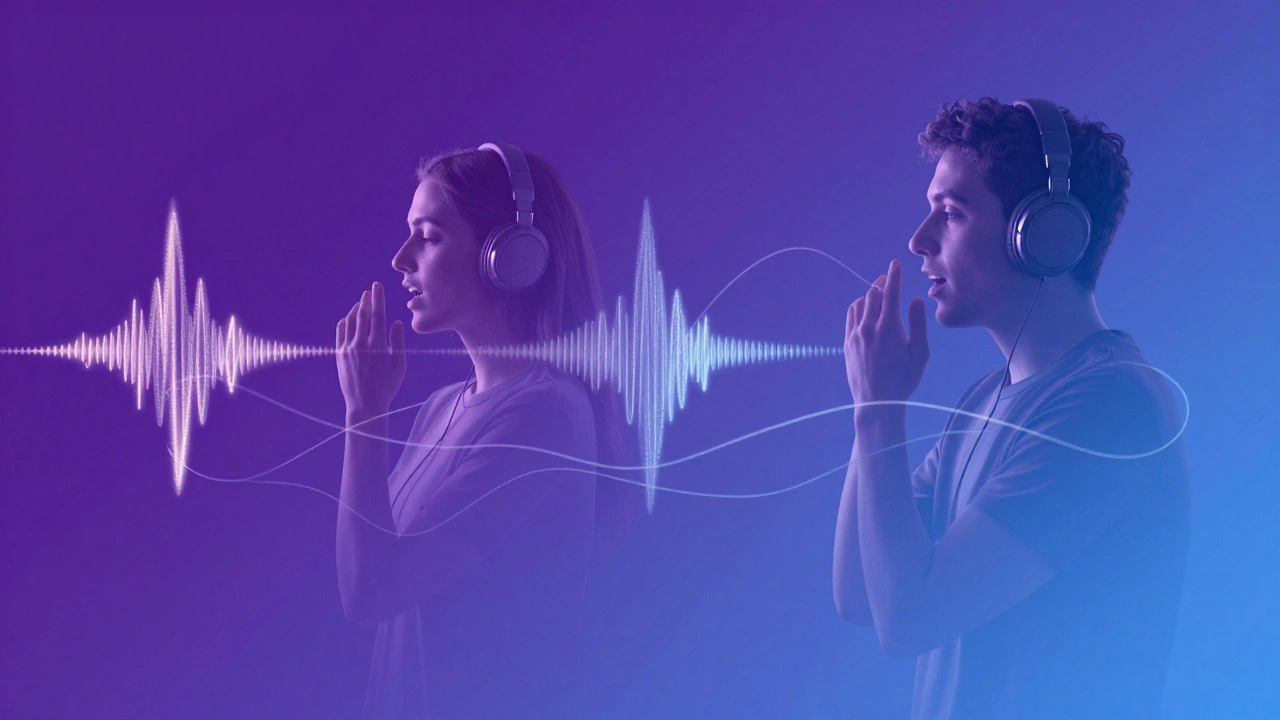
If you don't have a partner to practice with, Shadowing is your best friend. This isn't just repeating a word after a speaker; it's acting as a "shadow." You listen to a native speaker and repeat what they say with as little delay as possible-almost at the same time. You aren't just copying words; you're copying the speed, the pauses, and the melody of the sentence.
Try using a podcast or a TED Talk. Start with a transcript. Read it once to understand the meaning, then listen and repeat. Notice how native speakers blend words together-for example, "want to" becomes "wanna" or "going to" becomes "gonna." This is called Connected Speech. If you only learn words in isolation, you'll sound like a robot and, more importantly, you'll struggle to understand others because they aren't speaking in a textbook manner.
Stop Translating in Your Head
The biggest bottleneck in fluency is the translation loop: Hear English $\rightarrow$ Translate to native language $\rightarrow$ Think of answer $\rightarrow$ Translate to English $\rightarrow$ Speak. This process is too slow for a real conversation and makes you sound hesitant.
You can break this loop by labeling your world. Start small. When you see a chair, don't think "Silla" (if you speak Spanish) and then "Chair." Just look at the object and think "Chair." As you progress, move to internal monologues. Describe your day to yourself as if you're narrating a movie. "I'm waking up now, I'm going to make some coffee, I wonder if it's going to rain today." By doing this, you're training your brain to associate thoughts directly with English words, skipping the middleman.
Leveraging Modern Tools and AI
We live in an era where you can practice speaking 24/7 without paying for an expensive private tutor. Large Language Models (LLMs) like those found in ChatGPT now have advanced voice modes. You can literally tell the AI, "Act as a grumpy waiter at a New York diner and let me practice ordering food," and it will engage with you in real-time.
Another powerful approach is using Language Exchange platforms. These apps connect you with people who want to learn your language in exchange for teaching you theirs. The key here is structure. Don't just say "Hi, how are you?" For 30 minutes. Instead, set a topic: "Today, let's talk about our favorite childhood movies." Having a concrete subject forces you to use specific vocabulary and prevents the conversation from stalling.
| Method | Best For | Effort Level | Main Benefit |
|---|---|---|---|
| Shadowing | Pronunciation & Rhythm | High | Sounds more native |
| AI Voice Chat | Low-pressure practice | Medium | Instant feedback |
| Language Exchange | Real-world interaction | Medium | Cultural nuance |
| Internal Monologue | Thinking speed | Low | Removes translation |
Expanding Your Active Vocabulary
There is a huge difference between your passive vocabulary (words you understand) and your active vocabulary (words you actually use). Most learners have a passive vocabulary that is five times larger than their active one. To close this gap, you need to move words from the "recognition" folder to the "production" folder in your brain.
Stop memorizing long lists of random words. Instead, learn Collocations. These are words that naturally go together. For example, in English, we say "fast food," not "quick food," even though both words mean the same thing. If you learn collocations, your speaking sounds more natural and you don't have to think as hard about which adjective to use. Try keeping a "phrasebook" of common expressions you hear in movies and try to use each one at least three times in a conversation the next day.

Dealing with Mistakes and Feedback
The fear of making a mistake is the number one killer of fluency. But here is a secret: native speakers make mistakes all the time. We use wrong tenses, we forget words, and we stutter. The difference is that we don't stop the conversation to apologize for it. We just keep going.
If you are working with a teacher or a partner, ask for "delayed correction." This means they shouldn't interrupt you every time you miss an "s" at the end of a verb. Instead, they should take notes and give you a list of corrections at the end of the session. This allows you to maintain your flow and build confidence, while still ensuring you don't keep repeating the same errors.
How long does it take to speak English fluently?
Fluency isn't a destination; it's a spectrum. However, for a learner at an intermediate level, spending 30 to 60 minutes of active speaking practice daily can lead to a noticeable jump in confidence and flow within 3 to 6 months. The speed of progress depends more on the intensity of active production than the number of years spent studying grammar.
Can I improve my speaking without a partner?
Yes. You can use the shadowing technique, record yourself speaking and play it back to identify errors, and use AI-powered voice assistants. Thinking in English and narrating your actions are also powerful solo methods to build the mental pathways needed for speaking.
Should I focus on my accent or my grammar first?
Neither. Focus on clarity and intelligibility. An accent is a part of your identity and doesn't hinder communication as long as your pronunciation is clear. Grammar is important, but over-focusing on it during speaking creates a mental block. Prioritize being understood over being "perfect."
What is the best way to learn new words for speaking?
Learn words in context. Instead of a list, learn phrases. For example, instead of just learning the word "decision," learn the phrase "make a decision." This teaches you how the word actually functions in a sentence and prevents awkward phrasing when you speak.
How do I stop feeling nervous when speaking to natives?
Start with "low-stakes" environments. Talk to AI, then to other learners, then to friendly natives in casual settings (like a coffee shop). Remember that most native speakers are happy you're trying to learn their language and are generally patient. Focus on the message you want to convey, not the grammar you're using.
Next Steps for Your Journey
If you're feeling overwhelmed, don't try to do everything at once. Pick one method and stick with it for two weeks. If you're a total beginner, start with narrating your day. If you're intermediate, start shadowing a podcast for 10 minutes a morning. The only way to truly improve your speaking is to actually speak. Your brain needs to build the physical muscle memory of forming these sounds. Get out there, make mistakes, and keep talking.