CBSE vs State Board Comparison Tool
This tool helps you understand the key differences between CBSE and state board education systems. Select your focus to see detailed comparisons and personalized recommendations based on your situation.
Key Comparison Features
| Feature | CBSE |
|---|---|
| Scope | National and international |
| Syllabus Focus | Conceptual, exam-oriented (JEE, NEET aligned) |
| Exams | Class 10 and 12 board exams |
| Schools | Over 27,000 in India |
| Recognition | Universities and competitive exams nationwide |
| Language | Primary medium: English |
Which Board Is Right For You?
Select your situation to get personalized recommendations:
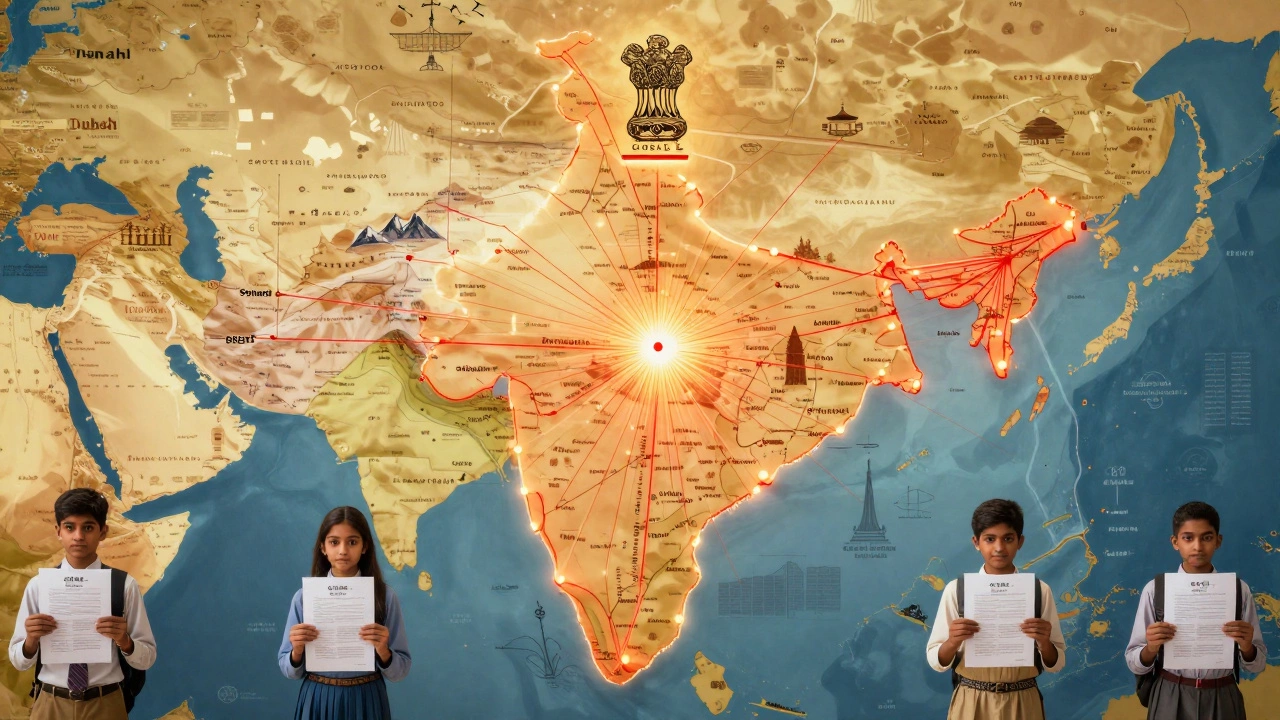
Many people assume CBSE is a Delhi board because its headquarters are in Delhi. That’s not wrong-but it’s also not the whole story. CBSE isn’t just a Delhi board. It’s a national board that governs school education across India and even in some countries abroad. If you think CBSE only serves Delhi, you’re missing how deeply it’s woven into India’s education system.
What CBSE Actually Is
CBSE stands for the Central Board of Secondary Education. It was established in 1962 and operates under the Union Ministry of Education, Government of India. Unlike state boards-like Maharashtra’s SSC or Tamil Nadu’s Samacheer Kalvi-CBSE doesn’t belong to any single state. It was created to standardize education for children of central government employees who move frequently across states. Today, it serves over 27,000 schools in India and more than 260 schools in 30 other countries.
Its curriculum is designed to be uniform, so a student in Jammu can switch to a school in Bangalore without facing major gaps in learning. That’s why CBSE is so popular among families who relocate often. It’s not about location-it’s about consistency.
Why People Think CBSE Is a Delhi Board
The confusion makes sense. CBSE’s headquarters are in New Delhi, specifically in the Shiksha Kendra complex near the Central Secretariat. The board’s administrative offices, exam centers for national-level coordination, and the main decision-making body are all based there. So when someone says, “CBSE is from Delhi,” they’re not lying-they’re just being incomplete.
Think of it like the Reserve Bank of India. Its headquarters are in Mumbai, but that doesn’t make it a Mumbai-only bank. Same logic applies here. Delhi is where CBSE is run from, not where it’s limited to.
CBSE vs. State Boards: Key Differences
Understanding CBSE’s role becomes clearer when you compare it to state boards.
| Feature | CBSE | State Board (e.g., Maharashtra SSC) |
|---|---|---|
| Scope | National and international | State-specific |
| Syllabus Focus | Conceptual, exam-oriented (JEE, NEET aligned) | Local language, regional content |
| Exams | Class 10 and 12 board exams | State-specific board exams |
| Schools | Over 27,000 in India | Varies by state (e.g., 30,000+ in Maharashtra) |
| Recognition | Universities and competitive exams nationwide | Primarily recognized within the state |
State boards often teach in the local language and focus on regional history, culture, and literature. CBSE uses English as the primary medium and follows a national curriculum designed with input from NCERT (National Council of Educational Research and Training). That’s why CBSE students tend to perform better in national-level exams like JEE, NEET, and Olympiads.
Who Runs CBSE? And Where?
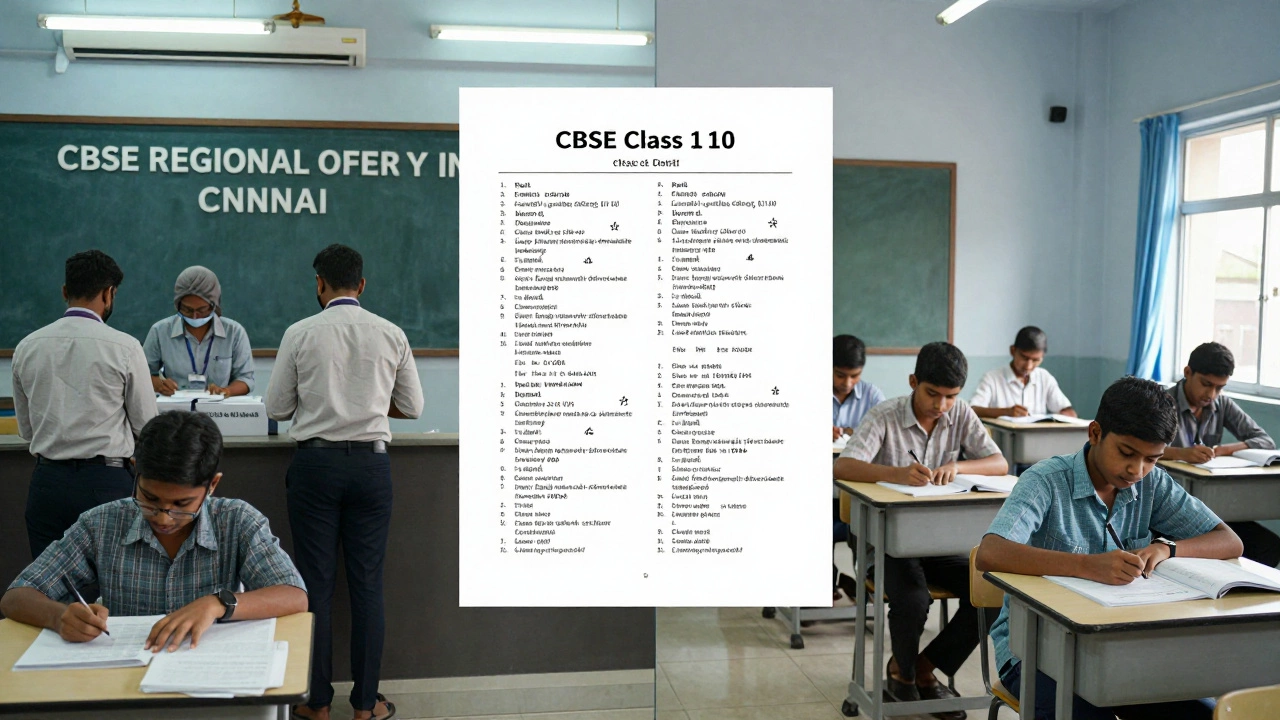
The board is led by a Chairperson appointed by the Government of India. The administrative structure includes regional offices in major cities like Chennai, Pune, and Kolkata. These offices handle local exam coordination, teacher training, and school inspections. So while the head office is in Delhi, the work happens everywhere.
For example, if you take your Class 10 exam in Guwahati, the question papers are printed and distributed by the CBSE regional office in Shillong. The answer sheets are evaluated locally, then sent to Delhi for final processing. The system is decentralized-but controlled from the center.
Does CBSE Have Anything to Do with Delhi’s Schools?
Yes, but not exclusively. Delhi has hundreds of CBSE-affiliated schools-some of the most prestigious ones, like Delhi Public School (DPS) branches and St. Xavier’s. But Delhi also has its own state board schools, managed by the Directorate of Education, Delhi. So even within Delhi, students can be under CBSE, Delhi state board, or ICSE.
Parents often choose CBSE in Delhi because it aligns better with competitive exams and offers more mobility if they plan to move out of the city. But that’s a choice-not a requirement.
What About Schools Outside India?
CBSE runs schools abroad too. There are CBSE-affiliated schools in Dubai, Abu Dhabi, Singapore, and even in countries like Kenya and Germany. These schools follow the same syllabus and conduct the same exams as schools in India. A child in Dubai can sit for the CBSE Class 12 exam at the same time as a child in Varanasi. That’s how standardized it is.
That global presence is another reason CBSE can’t be called a Delhi board. It’s an Indian national system with international reach.
Why This Misconception Matters
Believing CBSE is just a Delhi board can lead to bad decisions. A family moving from Kerala to Rajasthan might avoid CBSE schools thinking they’re only available in North India. Or a student might think their CBSE certificate won’t be valid outside Delhi. Neither is true.
CBSE is recognized by all Indian universities, foreign institutions, and competitive exam bodies like the UPSC. Its syllabus is accepted for admissions to IITs, NITs, AIIMS, and even universities in the UK, Australia, and Canada.
Final Answer: Is CBSE a Delhi Board?
No. CBSE is not a Delhi board. It’s a national board headquartered in Delhi. The location of its office doesn’t define its scope. It’s like saying the United Nations is a New York board because its headquarters are there. It’s a national-and global-system with a central hub.
If you’re choosing a board for your child, don’t ask, “Is this a Delhi board?” Ask: “Does this board support my child’s goals-whether they’re aiming for engineering, medicine, or studying abroad?” That’s the real question.
Is CBSE only for students in Delhi?
No. CBSE is a national board with schools in all 28 Indian states and over 30 countries. Students from any location can enroll in a CBSE-affiliated school. The board’s headquarters are in Delhi, but its operations and student base are nationwide.
Do CBSE schools teach in Hindi?
CBSE allows schools to offer Hindi as a subject, and some schools use Hindi as a medium of instruction. But the official language of instruction and examination is English. NCERT textbooks, which form the core of the CBSE curriculum, are primarily in English, though translations exist.
Can I switch from a state board to CBSE in Class 11?
Yes, you can switch from a state board to CBSE in Class 11, but you may need to clear a bridging course or subject gap assessment. CBSE schools usually require students to demonstrate readiness for their curriculum, especially in subjects like Physics, Chemistry, and Mathematics. It’s common, but not automatic.
Are CBSE exams easier than state board exams?
Not necessarily easier-just different. CBSE exams focus on conceptual understanding and are aligned with national competitive exams like JEE and NEET. State board exams often test memorization of local content. CBSE papers are generally considered more structured and predictable, which helps students prepare systematically.
Does CBSE have its own textbooks?
Yes. CBSE follows NCERT textbooks, which are developed by the National Council of Educational Research and Training. These books are used in all CBSE-affiliated schools across India. They’re available in print and free online in multiple languages.
What Comes Next?
If you’re a parent deciding between boards, look at your child’s future-not just their current location. Are they aiming for engineering? Medicine? Studying abroad? CBSE gives you a clear, nationally recognized path. If you’re in a state with a strong local board, don’t assume it’s better. Compare syllabi, exam patterns, and college admission trends.
CBSE isn’t about Delhi. It’s about access, consistency, and opportunity-for students everywhere.